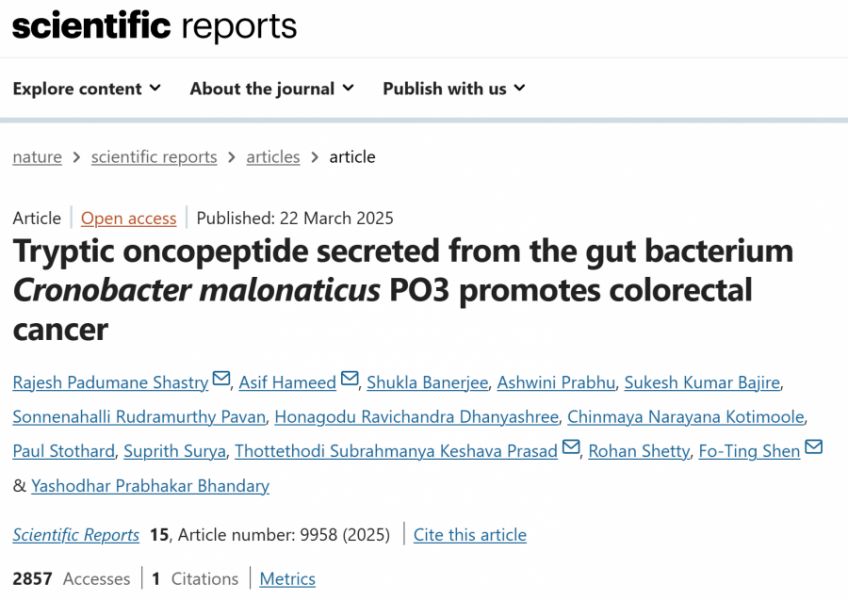
【學術亮點】Tryptic oncopeptide secreted from the gut bacterium Cronobacter malonaticus PO3 promotes colorectal cancer
Recycling Agriculture: Development of Integrated All-in-One Technology for the Innovative carbon sequestration of Organic Circular Agriculture【Department of Soil Environmental Sciences / Shen, Fo-Ting / Professor】
循環農業:農業有機循環再利用的多合一創新碳匯技術開發【土壤環境科學系/沈佛亭教授】
| 論文篇名 | 英文:Tryptic oncopeptide secreted from the gut bacterium Cronobacter malonaticus PO3 promotes colorectal cancer 中文:腸道細菌Cronobacter malonaticus PO3分泌之胰蛋白酶性癌肽促進結直腸癌的生成研究 |
| 期刊名稱 | Scientific Reports |
| 發表年份,卷數,起迄頁數 | 2025, 15, no.9958 |
| 作者 | Shastry, Rajesh Padumane; Hameed, Asif; Banerjee, Shukla; Prabhu, Ashwini; Bajire, Sukesh Kumar; Pavan, Sonnenahalli Rudramurthy; Dhanyashree, Honagodu Ravichandra; Kotimoole, Chinmaya Narayana; Stothard, Paul; Surya, Suprith; Keshava Prasad, Thottethodi Subrahmanya; Shetty, Rohan; Shen, Fo-Ting(沈佛亭)*; Bhandary, Yashodhar Prabhakar |
| DOI | 10.1038/s41598-025-94666-y |
| 中文摘要 | Cronobacter 屬細菌常與腦膜炎及壞死性小腸結腸炎相關,但其在人類結直腸癌中的作用仍未被探討。在本研究中我們自一名結腸癌患者的糞便樣本中分離並鑑定出一株新的 C. malonaticus 菌株,命名為 PO3,並證實該菌株在體外與體內皆可促進結直腸癌細胞的增殖。研究顯示PO3 的分泌蛋白組顯著促進細胞增生,具體表現為細胞活性提高、螢光強度增強及Ki-67 蛋白表現上升,且未引起細胞死亡。此外透過高解析質譜分析,在 PO3 的分泌蛋白中鑑定出一種新的胰蛋白酶性癌肽,命名為 P506,該肽可促進結直腸癌發展。合成的 P506 進一步在人類結直腸腺癌細胞株 HT-29 中顯示出劑量依賴性的細胞增殖效應。體內實驗使用 BALB/c 小鼠模型顯示,PO3 的分泌蛋白及 P506 均會誘導結腸息肉形成及伴隨的組織學變化,包括發育異常與結腸結構改變。綜合結果顯示,P506 是源自 PO3 分泌蛋白組的一種強效肽分子,具有致癌潛能,可能參與並促進結直腸癌的生成。 |
| 英文摘要 | The involvement of Cronobacter, which is frequently associated with meningitis and necrotizing enterocolitis, in human colorectal cancer remains unexplored. In this study, we isolate and characterize a novel strain of C. malonaticus designated PO3 from a fecal sample of a colon cancer patient and demonstrate its proliferative effects on colorectal cancer both in vitro and in vivo. The secretome of PO3 significantly promoted cell proliferation, as evidenced by increased cell viability, fluorescence intensity, and Ki-67 expression, without inducing cell death. Furthermore, using high-resolution mass spectrometry (HRMS), we identified a novel tryptic oncopeptide designated P506, in the PO3 secretome that promotes colorectal cancer. Synthetic P506 further stimulated human colorectal adenocarcinoma cell line HT-29 cell proliferation in a dose-dependent manner. Experiments with the BALB/c mouse model in vivo revealed that both the PO3 secretome and P506 contributed to the development of colorectal polyps and associated histological changes, including dysplasia and altered colonic architecture. These findings suggest that P506, a potent peptide from the PO3 secretome, may have oncogenic potential, promoting colorectal cancer progression. |
| 發表成果與本中心研究主題相關性 | 本研究指出腸道菌株 C. malonaticus PO3 及其肽 P506 對結直腸癌的促進作用,突顯人類與微生物間的健康風險關聯。對永續農業而言,深入了解微生物代謝與宿主影響,有助於發展安全菌株應用、生物防治與食品安全策略,推動健康導向與永續兼容的農業創新。 |