【學術亮點】Impedimetric Detection of Salmonella enterica in a Microfluidic Chip Using Aptamer-Modified Magnetic Beads and Dielectrophoretic Concentration
Facility Agricultural: Utilization of Livestock Waste in Automated Cultivation of Microalgae and Reutilization in Poultry Farming【Department of Bio-industrial Mechatronics Engineering / Wu, Ching-Chou / Distinguished Professor】
設施農業:畜牧廢棄物於小球藻自動栽培與禽類再利用【生物產業機電工程學系/吳靖宙特聘教授】
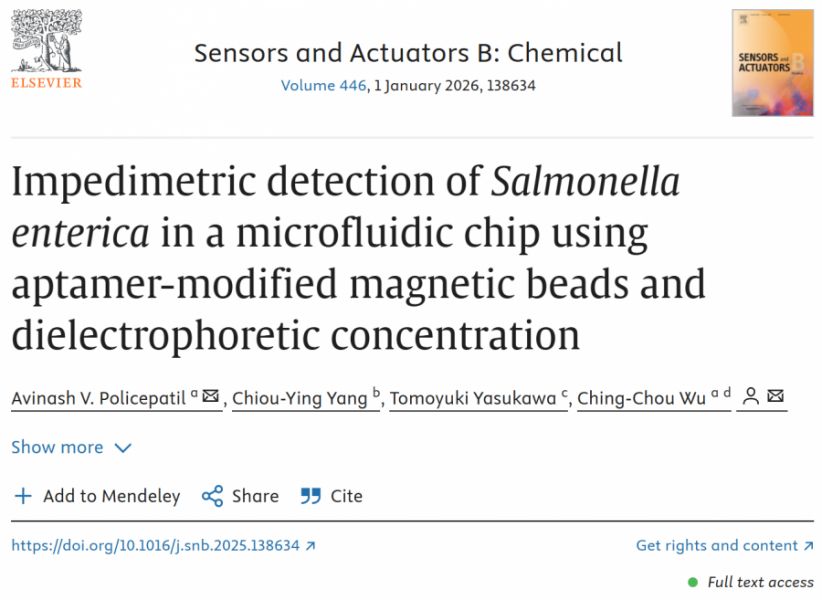
| 論文篇名 | 英文:Impedimetric Detection of Salmonella enterica in a Microfluidic Chip Using Aptamer-Modified Magnetic Beads and Dielectrophoretic Concentration 中文:以核酸適體修飾磁珠與介電泳濃縮之微流體晶片進行腸沙門氏菌(Salmonella enterica)的阻抗式檢測 |
| 期刊名稱 | SENSORS AND ACTUATORS B-CHEMICAL |
| 發表年份,卷數,起迄頁數 | 2026, 446, 138634 |
| 作者 | V. Policepatil, Avinash; Yang, Chiou-Ying; Yasukawa, Tomoyuki; Wu, Ching-Chou(吳靖宙)* |
| DOI | 10.1016/j.snb.2025.138634 |
| 中文摘要 | 食源性沙門氏菌污染對公共衛生造成重大威脅,急需快速且可靠的檢測方法。本研究提出一種高靈敏度的阻抗式微流體平台,用於偵測腸沙門氏菌 Salmonella enterica 之 Choleraesuis 血清型(簡稱 SAL),並於經人為汙染的雞肉與未稀釋牛奶樣品中驗證。系統首先以核酸適體功能化之磁珠(AMBs)自食物基質中捕捉 SAL;隨後將形成之 AMBs@SAL 複合物,在微流體通道內施加正介電泳(pDEP;50 kHz、7.5 Vpp,3 分鐘),使其富集於工作電極(WE)的微孔結構上,並以電化學阻抗頻譜(EIS)定量 SAL 濃度。結果顯示,電子轉移電阻(Ret)的增量比值與 AMBs@SAL 的濃度呈直接相關。整體分析流程——包含 AMBs 與 SAL 的結合反應、磁性分離、pDEP 濃縮與 EIS 量測——可在 50 分鐘內完成。經再生處理後,無需額外表面修飾的微孔 WE 可進行可重複之 EIS 量測,進而延長其使用壽命。該微流體裝置的推算偵測極限為 1 CFU/mL,線性範圍為 101–105 CFU/mL。本方法提出一種快速且超高靈敏的 SAL 檢測方法,對食品安全檢測具備可觀的應用潛力。 |
| 英文摘要 | Foodborne Salmonella contamination remains a significant public health concern, necessitating rapid and reliable detection methods. This study presents a highly sensitive, impedimetric microfluidic platform for detecting Salmonella enterica serovar Choleraesuis (SAL) in artificially contaminated chicken meat and undiluted milk samples. Our system utilized aptamer-functionalized magnetic beads (AMBs) to capture SAL from food matrices. Then, the captured AMBs@SAL complexes were enriched in the microhole structures of the working electrode (WE) in the microfluidic channel by applying positive dielectrophoresis (pDEP) of the 50-kHz and 7.5-Vpp voltage for 3 min, followed by electrochemical impedance spectroscopy (EIS) to quantify the SAL concentrations. The electron-transfer resistance (Ret) increment ratio directly correlates with AMBs@SAL concentrations. The complete analytical workflow, including the AMBs immunoreaction with SAL, the magnetic separation, the pDEP enrichment, and EIS measurement, can be completed in less than 50 min. After regeneration, the modification-free microhole WEs can perform reproducible EIS measurements to extend their lifetime. The microfluidic device achieves an impressive calculated detection limit of 1 CFU/mL and a 101–105 CFU/mL linear range. The proposed method offers a promising potential for rapid and ultrasensitive SAL detection in food safety applications. |
| 發表成果與本中心研究主題相關性 | 本研究提出一種阻抗式感測器,用於偵測腸沙門氏菌。利用在微流體通道內施加正介電泳,使磁珠富集於工作電極上,並以電化學阻抗頻譜定量 SAL 濃度。本方法提出一種快速且超高靈敏的 SAL 檢測方法,對食品安全檢測具備可觀的應用潛力。 |