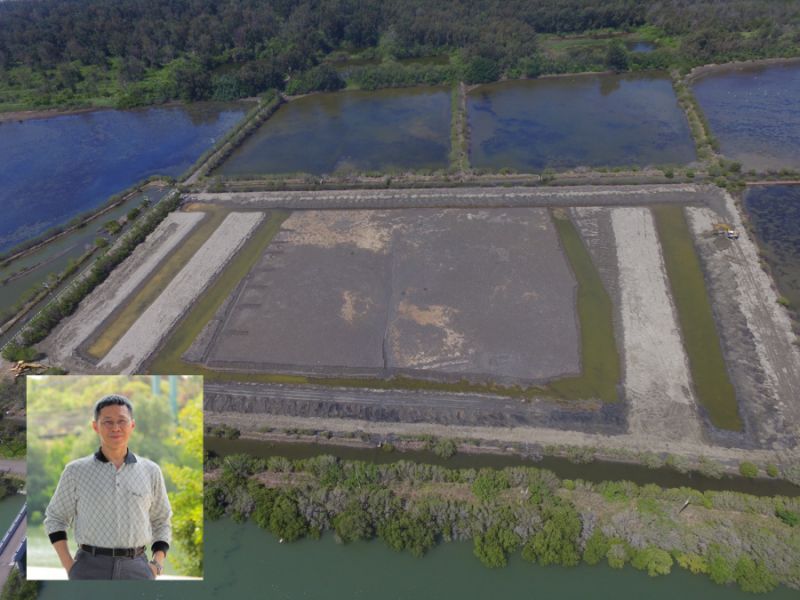
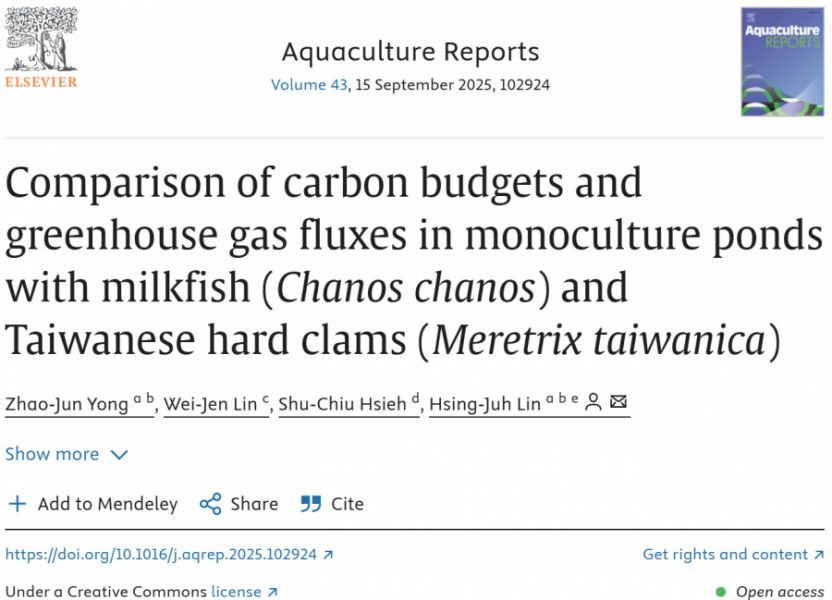
【學術亮點】Comparison of carbon budgets and greenhouse gas fluxes in monoculture ponds with milkfish (Chanos chanos) and Taiwanese hard clams (Meretrix taiwanica)
Ecological Agriculture: Nature-Based Solutions for Restoring Wetland Carbon Sink under Climate Change【Department of Life Sciences / Lin, Hsing-Juh / Distinguished Professor】
生態農業:氣候變遷下以自然為本之濕地碳匯復育策略【生命科學系/林幸助特聘教授】
| 論文篇名 | 英文:Comparison of carbon budgets and greenhouse gas fluxes in monoculture ponds with milkfish (Chanos chanos) and Taiwanese hard clams (Meretrix taiwanica) 中文:虱目魚與文蛤養殖碳收支比較 |
| 期刊名稱 | Aquaculture Reports |
| 發表年份,卷數,起迄頁數 | 2025, 43, no.102924 |
| 作者 | Yong, Zhao-Jun; Lin, Wei-Jen; Hsieh, Shu-Chiu; Lin, Hsing-Juh(林幸助)* |
| DOI | 10.1016/j.aqrep.2025.102924 |
| 中文摘要 | 水產養殖在滿足不斷增長的水產食品需求方面發揮著至關重要的作用。然而,對水產養殖池塘碳通量的研究仍然有限。本研究建構了碳收支,並確定了文蛤(Meretrix taiwanica)和虱目魚(Chanos chanos)單一養殖池塘的溫室氣體(GHG)排放量。浮游植物的產生構成了文蛤 (72-85%) 和虱目魚 (41-48%) 池的主要碳輸入途徑。然而,呼吸作用抵消了大部分碳,將魚塘變成了平均排放 0.21 g C m-2 d-1 的異營系統。相比之下,文蛤池仍然是自營系統,充當碳匯,平均吸收量為 0.06 g C m-2 d-1,即使考慮到生物鈣化釋放的二氧化碳。堆積的沉積物對池塘的碳輸出途徑有顯著貢獻,佔文蛤池的62-77%和魚池的23-52%。一條不明的碳輸入途徑可能導致文蛤濾食行為導致文蛤池中沉積物的積累,從而導致重新懸浮或擬糞的產生。另一方面,飼料投入主要導致魚池沉積物堆積。甲烷通量、生物鈣化、水交換和雨水在這兩個碳收支中所佔的比例相對較小。以百年全球暖化潛能值(GWP100)計算,養殖期間的溫室氣體排放量為文蛤池0.46 ± 0.75 g CO2e m-2 d-1,虱目魚池1.15 ± 1.15 g CO2e m-2 d-1。甲烷通量對兩種魚塭的整體溫室氣體排放量的貢獻相對較小,而氧化亞氮通量可以將魚池變成更大的溫室氣體來源。 |
| 英文摘要 | Aquaculture plays a vital role in meeting the growing demand for aquatic food. However, research on carbon fluxes in aquaculture ponds remains limited. This study constructed carbon budgets and determined greenhouse gas (GHG) emissions from monoculture ponds of Taiwanese hard clams (Meretrix taiwanica) and milkfish (Chanos chanos). Phytoplankton production constituted the major carbon input pathways in the clam (72–85%) and fish (41–48%) ponds. However, respiration offset most of the carbon, which turned the fish ponds into heterotrophic systems that emitted an average of 0.21 g C m-2 d-1. In contrast, the clam ponds remained autotrophic systems, functioning as a carbon sink with an average uptake of 0.06 g C m-2 d-1, even when accounting for the CO2 release by biocalcification. The accumulated sediment significantly contributed to the carbon output pathways in the ponds, accounting for 62–77% of those in the clam ponds and 23–52% of those in the fish ponds. An unaccounted pathway of carbon input likely contributed to sediment accumulation in the clam ponds caused by the filter-feeding behavior of clams, which induces resuspension or the production of pseudofeces. On the other hand, feed input mainly contributed to sediment accumulation in the fish pond. Methane flux, biocalcification, water exchange, and rainwater accounted for relatively small portions of both carbon budgets. Based on the 100-year global warming potential (GWP100), the GHG emissions during the culture period were 0.46 ± 0.75 g CO2e m-2 d-1 in the clam ponds and 1.15 ± 1.15 g CO2e m-2 d-1 in the fish ponds. Methane fluxes contribute relatively little to the overall GHG emissions from both ponds, while nitrous oxide fluxes can alter the fish ponds into a greater GHG source. |
| 發表成果與本中心研究主題相關性 | 農業碳匯之估算 |