【學術亮點】Environmental exposures related to gut microbiota among children with asthma: a pioneer study in Taiwan
Ecological Agriculture: Assessment of Forest Carbon Sink and Ecological Economy under Climate Change【 Department of Geomatics, National Cheng Kung University / Wu, Chih-Da / Professor】
生態農業:氣候變遷下森林碳匯與生態經濟評估【國立成功大學測量及空間資訊學系/吳治達教授】
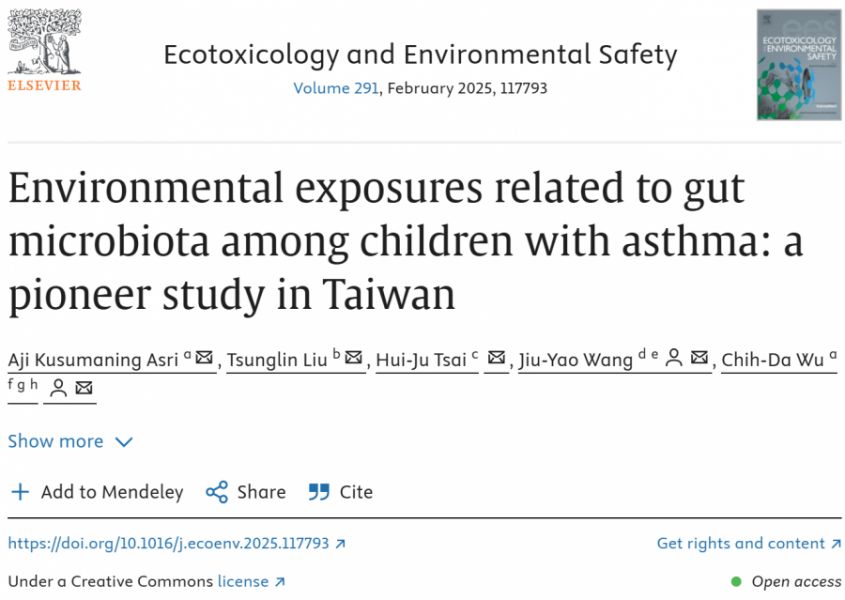
| 論文篇名 | 英文:Environmental exposures related to gut microbiota among children with asthma: a pioneer study in Taiwan 中文:台灣氣喘兒童腸道微生物與環境暴露關聯之先驅研究 |
| 期刊名稱 | Ecotoxicology and Environmental Safety |
| 發表年份,卷數,起迄頁數 | 2025, 291, no.117793 |
| 作者 | Asri, Aji Kusumaning; Liu, Tsunglin; Tsai, Hui-Ju; Wang, Jiu-Yao; Wu, Chih-Da(吳治達)* |
| DOI | 10.1016/j.ecoenv.2025.117793 |
| 中文摘要 | 本研究成果顯示,腸道微生物組不僅深受空氣污染與綠地環境影響,還在兒童哮喘等脆弱族群的免疫功能中扮演關鍵角色。結果發現,短期暴露於 NO₂、PM2.5 與 O₃ 會降低腸道細菌多樣性與豐富度,進而影響健康風險;相對地,居住環境中綠地比例越高,則對腸道微生物多樣性具有正面作用。這不僅揭示了都市規劃與環境管理對兒童健康的長期影響,也提供了以「減少污染、增加綠地」為核心的公共衛生與永續發展策略。藉由將空氣品質改善與生態綠地建設納入政策規劃,能夠同時達成減少環境風險、促進免疫健康、提升社會韌性的多重效益,對推動健康城市與永續社會具有重要啟發。 |
| 英文摘要 | Gut microbiota plays a crucial role in human health and can be influenced by environmental factors. While past studies have examined the impact of the environment on gut microbiota, vulnerable populations have often been overlooked. This study aimed to investigate the association between environmental exposures, air pollution and greenspace, and gut microbiota in asthmatic children. Data were collected during the recovery period for 41 eligible children. Air pollution was estimated using an ensemble learning model that combined regression and machine-learning algorithms, while greenspace was quantified using the normalized difference vegetation index (NDVI) and green land-cover data. The lag effects of exposures were assessed within defined buffer zones surrounding each child's residence. A generalized additive model was applied to examine associations. Results revealed a marginally significant negative association between 1-day lag exposure to NO₂ and gut microbiota indices, such as observed bacteria (Coef.: −1.130; 95 %CI −2.287, 0.027) and bacterial richness (Coef.: −2.420; 95 %CI −4.987, 0.146). The 8-day lagged average exposure to PM2.5 and O₃ also showed negative impacts on bacterial diversity. In contrast, the 1-month lagged average exposure to greenspace was positively associated with microbiota indices. Air pollution and greenspace were also linked to specific bacterial abundances, such as Streptococcus. This study underscores the need for further research on how environmental factors may influence immunity in asthmatic children by altering gut microbiota. |
| 發表成果與本中心研究主題相關性 | 本研究揭示空氣污染與綠地暴露不僅影響兒童腸道微生物多樣性,也間接反映了人類健康與環境品質之間的緊密關聯。此成果對永續農業具有重要啟發,因為農業生產系統同樣依賴於健康的微生物生態。綠地的存在能促進有益微生物群落的維持,減緩污染對生態與健康的負面影響,這與農業土壤中微生物的角色高度類似。藉由強調「增加綠地、減少污染」對腸道菌相與免疫力的正面效應,研究結果同時支持在農業領域推動生態農法、減少化學農藥使用、提升農地綠覆率等措施。這不僅能維持農田土壤微生物多樣性、提升作物健康與抗逆力,更有助於降低環境污染對糧食安全與人類健康的風險,進而推動農業與公共衛生雙贏的永續發展。 |