【學術亮點】Photochemical oxidation of Cr(III) to Cr(VI) in the presence of Fe(III): Influence of Fe(III) concentration and UV wavelength
Ecological Agriculture: Optimization and Validation of Soil Carbon Sequestration Prediction Models【Department of Soil Environmental Sciences / Tzou, Yu-Min / Distinguished Professor、Liu, Yu-Ting / Distinguished Professor】
生態農業:土壤碳蓄存之預測模型優化及驗證【土壤環境科學系/鄒裕民特聘教授、劉雨庭特聘教授】
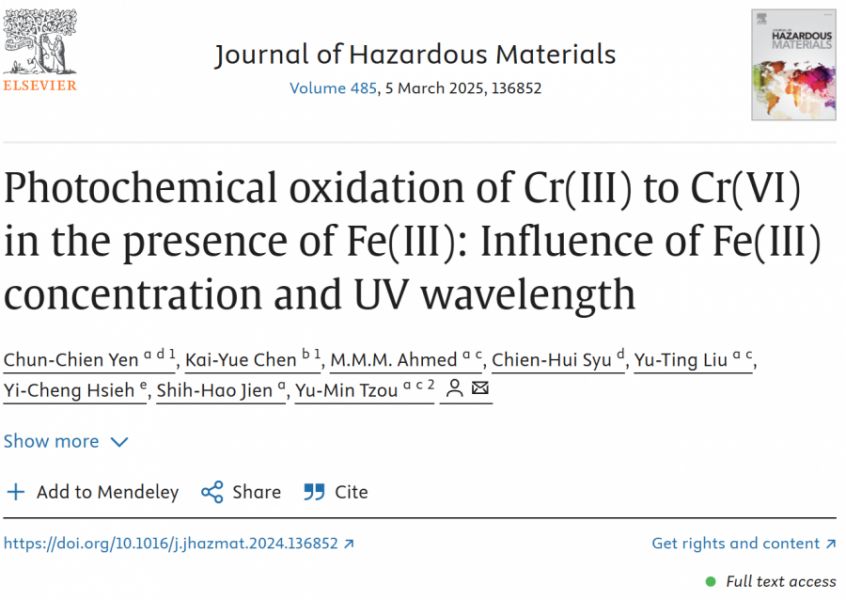
| 論文篇名 | 英文:Photochemical oxidation of Cr(III) to Cr(VI) in the presence of Fe(III): Influence of Fe(III) concentration and UV wavelength 中文:在 Fe(III) 存在下 Cr(III) 向 Cr(VI) 的光化學氧化:Fe(III) 濃度與紫外波長的影響 |
| 期刊名稱 | Journal of Hazardous Materials |
| 發表年份,卷數,起迄頁數 | 2025, 485, no. 136852 |
| 作者 | Yen, Chun-Chien; Chen, Kai-Yue; Ahmed, M. M. M.; Syu, Chien-Hui; Liu, Yu-Ting(劉雨庭); Hsieh, Yi-Cheng; Jien, Shih-Hao; Tzou, Yu-Min(鄒裕民)* |
| DOI | 10.1016/j.jhazmat.2024.136852 |
| 中文摘要 | Cr(VI) 向 Cr(III) 的還原對於降低環境毒性與遷移性至關重要,但其逆反應仍較少被理解。本研究探討了在 Fe(III) 存在下,不同 pH 條件與光波長(185、254 與 358 nm)下 Cr(III) 的氧化機制。在 pH 3.0 且 358 nm 光照下,Cr(VI) 生成量達到 11.65 μM,主要由光反應性 Fe(OH)²⁺ 產生的 •OH 自由基驅動。雖然 Fe(III) 一般促進 Cr(III) 的氧化,但當其濃度超過 0.5 mM 時,反而會抑制該過程。在 185 nm 光下氧化最為強烈,Cr(VI) 生成量高達 217 μM,原因是 Fe(III) 與水的光解作用共同貢獻。在 254 與 358 nm 光照下,•OH 僅由 Fe(III) 光解產生,此時 •OH 會氧化 Fe(II),而 Fe(II) 又會還原 Cr(VI),進而減緩 Cr(III) 的氧化。短波長、高能量的光能顯著增強 Cr(III) 的氧化。在此類紫外線照射下,大氣中含 Cr(III) 的氣膠與顆粒可能發生有害轉化,透過酸性沉降進入生態系統並帶來健康風險。 |
| 英文摘要 | The reduction of Cr(VI) to Cr(III) is key to lowering environmental toxicity and mobility, but the reverse process remains less understood. We investigated Cr(III) oxidation mechanisms across various pH levels and light wavelengths (185, 254, and 358 nm) in the presence of Fe(III). At pH 3.0 under 358 nm light, Cr(VI) production peaked at 11.65 μM, driven by photo-reactive Fe(OH)²⁺ producing •OH radicals. While Fe(III) generally promotes Cr(III) oxidation, concentrations above 0.5 mM inhibited the process. Oxidation was most intense under 185 nm light, generating up to 217 μM of Cr(VI), due to Fe(III) and water photolysis. At 254 and 358 nm, •OH was solely produced by Fe(III) photolysis, where •OH oxidized Fe(II), which then reduced Cr(VI), slowing Cr(III) oxidation. Short-wavelength, high-energy light significantly enhances Cr(III) oxidation. Under such UV exposure in the atmosphere, Cr(III)-containing aerosols and particles may undergo harmful transformations, potentially entering ecosystems via acidic deposition and posing health risks. |
| 發表成果與本中心研究主題相關性 | 本研究在探討大氣中的懸浮微粒若帶有重金屬物質, 這些重金屬會受到光的影響而發生轉變, 可能轉為具致癌性的汙染物而影響人類或生態健康, 成果與中心強調永續健康造福人類福祉的目標一致 |