Facility Agricultural: Green Energy Development and Carbon Offset【Graduate Institute of Optoelectronic Engineering / Pei, Zingway / Distinguished Professor】
設施農業:農業綠能開發與碳匯補償【光電工程研究所/裴靜偉特聘教授】
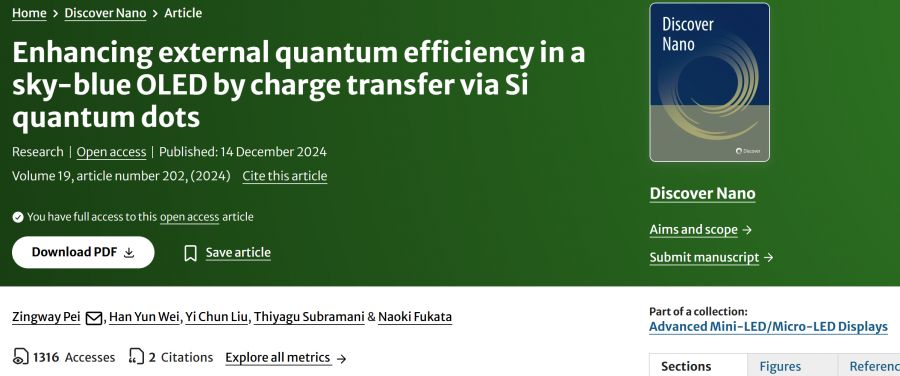
| 論文篇名 | Enhancing external quantum efficiency in a sky-blue OLED by charge transfer via Si quantum dots |
| 期刊名稱 | DISCOVER NANO |
| 發表年份,卷數,起迄頁數 | 2024, 19(1), no. 202 |
| 作者 | Pei, Zingway(裴靜偉); Wei, Han Yun; Liu, Yi Chun; Subramani, Thiyagu; Fukata, Naoki |
| DOI | 10.1186/s11671-024-04171-w |
| 中文摘要 | 有機發光二極體(OLED)希望利用激子達到100%的量子效率(QE)。然而,開發能實現這一目標的功能性有機材料往往曠日費時。為克服此瓶頸,研究人員提出一種新方法:將無機量子點嵌入有機發光層,使激子可無限生成,從而逼近100% QE 極限。無機量子點是由原子組成的奈米團簇,在導帶與價帶中擁有大量熱激發的電子與電洞。當量子點被「浸」入有機層後,便成為電荷生成中心,源源不絕地提供電子與電洞,形成無限量的激子。這些激子經輻射復合後產生光子,使內部量子效率接近100%。該概念已利用矽量子點(SiQDs)與磷光材料驗證。SiQDs 平均粒徑約6 nm,均勻分散於主客體藍色磷光發光材料中。僅在前驅物中添加 5×10⁻³ wt% 的 SiQDs,外部量子效率便由2%躍升至17.7%,提升近九倍。衰減時間從1.68 ns延長至5.97 ns,證實電子自SiQDs轉移至發光材料。此通用策略亦可擴展至綠光與紅光發射,適用於各種無機量子點與不同有機發光材料體系。 |
| 英文摘要 | Organic light-emitting diodes aim to achieve high efficiency by using excitons to achieve a 100% quantum efficiency (QE). However, developing functional organic materials for this purpose can be time-consuming. To address this challenge, a new method has been proposed to incorporate inorganic quantum dots into the organic luminescent layer to enable unlimited exciton formation and approach the 100% QE limit. Inorganic quantum dots are clusters of atoms that contain numerous thermally generated electrons and holes at conduction and valence bands. Immersed quantum dots act as charge generation centers, providing electrons and holes with unlimited amounts to form excitons. After radiative recombination, these excitons generate photons that cause internal QE to nearly 100%. This concept has been demonstrated using Silicon quantum dots (SiQDs) and phosphorescent materials. The average size of SiQDs is approximately 6 nm, and they are well-dispersed within the guest–host blue phosphorescent light-emitting materials. With only 5× 10⁻³% (in weight) of SiQDs in the precursor, external QE increased from 2 to 17.7%, nearly a nine-fold enhancement. The prolonged decay time from 1.68 to 5.97 ns indicates that electrons are transferred from SiQDs to the luminescent materials. This universal method can be applied to green and red emissions with various inorganic quantum dots in different organic luminescent material systems. |
| 發表成果與本中心研究主題相關性 | 提升OLED發光元件效率,可以應用於大面積發光源,促使植物生長。 |