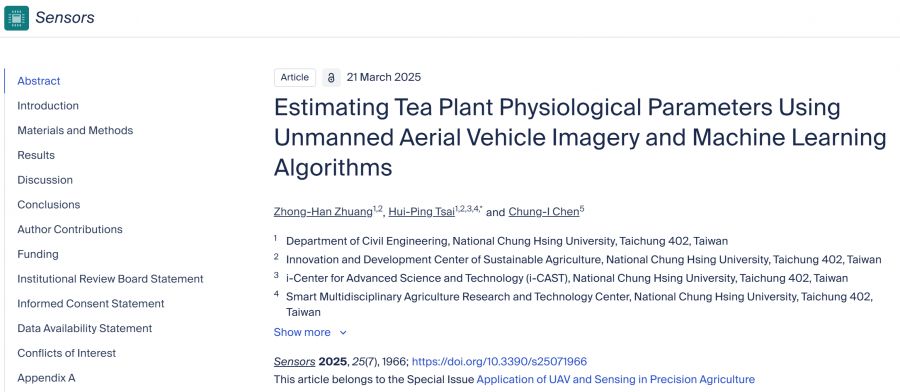
【學術亮點】Estimating Tea Plant Physiological Parameters Using Unmanned Aerial Vehicle Imagery and Machine Learning Algorithms
Technological Agriculture: Multi-Source Remote Sensing Image AI Recognition for Agriculture Greenhouse Gas Emission Assessment【Department of Civil Engineering / Tsai, Hui-Ping / Associate Professor】
科技農業:多元遙測影像AI辨識於農作溫室氣體排放評估【土木工程學系/蔡慧萍 副教授】
| 論文篇名 | 英文:Estimating Tea Plant Physiological Parameters Using Unmanned Aerial Vehicle Imagery and Machine Learning Algorithms 中文:應用無人機影像和機器學習演算法估算茶樹生理參數 |
| 期刊名稱 | Sensors |
| 發表年份,卷數,起迄頁數 | 2025, 25(7), no. 1966 |
| 作者 | Zhuang, Zhong-Han; Tsai, Hui-Ping(蔡慧萍)*; Chen, Chung-, I |
| DOI | 10.3390/s25071966 |
| 中文摘要 | 茶(Camellia sinensis L.)具有農業經濟價值和固碳潛力,且台灣每年的茶葉產量超過 70 億新台幣。然而,氣候變遷引起的壓力因素威脅著茶樹的生長、光合作用、產量和品質,因此目前需要建立準確的即時監測系統,以加強種植管理和生產穩定性。本研究調查了台灣中部南投縣低、中、高海拔的茶園,從 21 個茶園收集數據,研究區域包含採用強調集約化管理的傳統慣行農法 (CFM) 和優先考慮生態的生態友善農法 (AFM)。本研究將葉面積指數 (LAI)、光化學反射指數 (PRI) 和光系統 II 量子產量 (ΦPSII) 數據與無人機 (UAV) 獲得的可見光和多光譜影像相結合,以計算顏色指數 (CI) 和多光譜指數 (MI)。利用特徵排序方法,開發了最佳化的資料集,並評估了八種迴歸演算法在估算茶樹生理參數方面的預測性能。結果表明,在AFM模型中,葉面積指數(LAI)通常較低,這表明葉片生長密度和潛在產量差異較小。然而,PRI和ΦPSII值表明,與CFM模型相比,AFM模型具有更強的環境適應性和潛在的長期生態效益。在迴歸模型中,MI模型為茶樹生理參數提供了更高的穩定性,而特徵排序方法對準確性的影響較小。 XGBoost 模型在預測參數方面優於所有模型,在以下參數預測中取得了最佳效果:(1) LAI:R 2 = 0.716,RMSE = 1.01,MAE = 0.683;(2) PRI:R 2 = 0.643,RMSE = 0.013 , (2) PRI:R 2 = 0.643,RMSE = 0.013,MAE = 0.0099; 0.048,MAE = 0.013。總之,我們以XGBoost 模型與多光譜數據相結合可有效反映茶樹生理特性。本研究建立了可推廣的茶樹生理參數估計預測模型,可應用於茶園管理中非接觸式作物生理監測,為精準農業應用的重要科學基礎。 |
| 英文摘要 | Tea (Camellia sinensis L.) holds agricultural economic value and forestry carbon sequestration potential, with Taiwan’s annual tea production exceeding TWD 7 billion. However, climate change-induced stressors threaten tea plant growth, photosynthesis, yield, and quality, necessitating an accurate real-time monitoring system to enhance plantation management and production stability. This study surveys tea plantations at low, mid-, and high elevations in Nantou County, central Taiwan, collecting data from 21 fields using conventional farming methods (CFMs), which emphasize intensive management, and agroecological farming methods (AFMs), which prioritize environmental sustainability. This study integrates leaf area index (LAI), photochemical reflectance index (PRI), and quantum yield of photosystem II (ΦPSII) data with unmanned aerial vehicles (UAV)-derived visible-light and multispectral imagery to compute color indices (CIs) and multispectral indices (MIs). Using feature ranking methods, an optimized dataset was developed, and the predictive performance of eight regression algorithms was assessed for estimating tea plant physiological parameters. The results indicate that LAI was generally lower in AFMs, suggesting reduced leaf growth density and potential yield differences. However, PRI and ΦPSII values revealed greater environmental adaptability and potential long-term ecological benefits in AFMs compared to CFMs. Among regression models, MIs provided greater stability for tea plant physiological parameters, whereas feature ranking methods had minimal impact on accuracy. XGBoost outperformed all models in predicting parameters, achieving optimal results for (1) LAI: R2 = 0.716, RMSE = 1.01, MAE = 0.683, (2) PRI: R2 = 0.643, RMSE = 0.013, MAE = 0.009, and (3) ΦPSII: R2 = 0.920, RMSE = 0.048, MAE = 0.013. Overall, we highlight the effectiveness of integrating gradient boosting models with multispectral data to capture tea plant physiological characteristics. This study develops generalizable predictive models for tea plant physiological parameter estimation and advances non-contact crop physiological monitoring for tea plantation management, providing a scientific foundation for precision agriculture applications. |
| 發表成果與本中心研究主題相關性 | 此研究以科學角度,針對台灣中部三種海拔的慣行與生態友善茶園,除了分析兩種農法的作物生理特徵,也發展可以大面積可估算茶樹生理狀況的方法。具體而言,本研究應用無人機影像結合機器學習演算法,同步配合現地生理數值的量測,進行相互關聯性的分析討論,建立了創新可推廣的茶樹生理參數估計預測模型,能夠應用於茶園管理中非接觸式作物生理監測,是精準農業重要的科學基礎。 |