【學術亮點】Phase-Selective Crystallization of Glaukosphaerite and Malachite via Fluidized-Bed Homogeneous Process for Copper–Nickel Recovery from Electroplating Wastewater
Facility Agricultural: Utilization of Livestock Waste in Automated Cultivation of Microalgae and Reutilization in Poultry Farming【Department of Environmental Engineering / Lu, Ming-Chun / Distinguished Professor】
設施農業:畜牧廢棄物於小球藻自動栽培與禽類再利用【環境工程學系/盧明俊特聘教授】
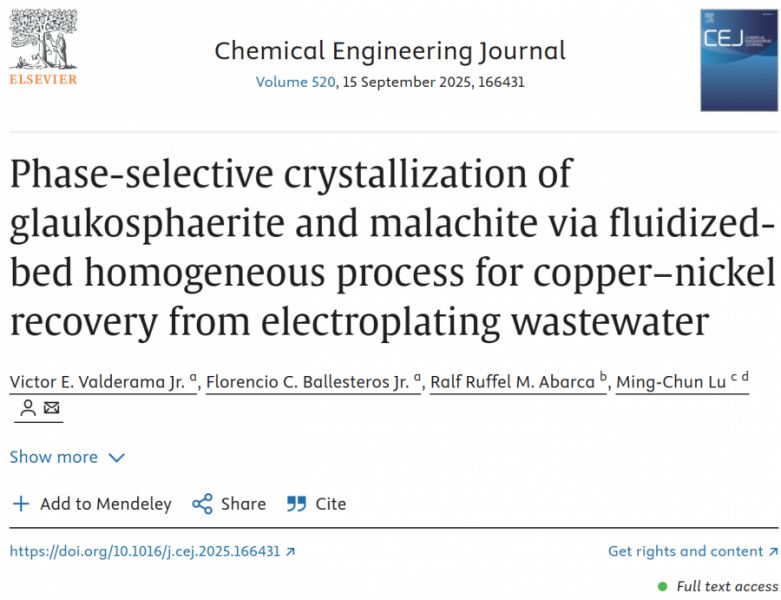
| 論文篇名 | 英文:Phase-Selective Crystallization of Glaukosphaerite and Malachite via Fluidized-Bed Homogeneous Process for Copper–Nickel Recovery from Electroplating Wastewater 中文:透過流體化床均質結晶製程選擇性結晶青球石與孔雀石以回收電鍍廢水中銅鎳離子 |
| 期刊名稱 | Chemical Engineering Journal |
| 發表年份,卷數,起迄頁數 | 2025, 520, no.166431 |
| 作者 | Valderama Jr, Victor E.; Ballesteros Jr, Florencio C.; Abarca, Ralf Ruffel M.; Lu, Ming-Chun(盧明俊)* |
| DOI | 10.1016/j.cej.2025.166431 |
| 中文摘要 | 電鍍廢水是銅與鎳污染的重要來源,這兩種金屬雖具毒性但亦具高價值。本研究展示流體化床均質結晶製程(FBHCP)應用於合成銅鎳廢水中無種晶、相選擇性結晶,成功生成青球石((Cu,Ni)₂(CO₃)(OH)₂)與孔雀石(Cu₂CO₃(OH)₂),未來仍需驗證其在實際電鍍廢水中的效能。雖未進行直接對照試驗,FBHCP相較傳統沉澱與吸附法(常產生非晶污泥)展現明顯優勢,可選擇性回收具結晶性的銅鎳碳酸鹽。研究採雙層設計策略,包括因子篩選與中央複合設計,優化pH值、[CO₃²⁻]/[金屬]莫耳比與進流水速率。在最佳條件(pH 9.0、莫耳比1.5、流速20 mL/min)下,銅與鎳的去除率分別達98.84%與90.13%,造粒效率為92.1%與86.12%。結晶由過飽和驅動並透過流體力學控制調節,銅遵循擬一級動力學。SEM–EDS分析顯示顆粒緻密且可重複使用(含35.05%鎳與19.26%銅),XRD鑑定青球石為主要相(占38.3%)。FBHCP提升製程永續性,減少污泥量、常溫操作並回收具附加價值的金屬固體,具備工業應用的節能與成本優勢。結晶產品在熱力與水力控制條件下形成,建議進一步穩定性測試以確認其安全再利用與儲存潛力。所回收固體可應用於催化劑、電池材料及電子廢棄物回收領域。本研究為首例多變數優化FBHCP架構,實現選擇性銅鎳碳酸鹽結晶,契合循環經濟原則。 |
| 英文摘要 | Electroplating wastewater is a critical source of copper and nickel contamination—two toxic yet valuable metals. This study demonstrates the application of the Fluidized-Bed Homogeneous Crystallization Process (FBHCP) to achieve unseeded, phase-selective crystallization of glaukosphaerite ((Cu,Ni)₂(CO₃)(OH)₂) and malachite (Cu₂CO₃(OH)₂) from synthetic copper–nickel wastewater, with future work needed to validate performance on real electroplating effluents. While no direct control study was conducted, FBHCP showed distinct advantages over conventional methods—such as precipitation and adsorption, which typically yield amorphous sludge—by enabling phase-selective recovery of crystalline copper–nickel carbonates. A two-tier design approach—comprising factorial screening and Central Composite Design—optimized pH, [CO₃2−]/[metal] ratio, and influent flow rate. Under optimal conditions (pH 9.0, molar ratio 1.5, influent flow rate 20 mL/min), copper and nickel removal efficiencies reached 98.84 % and 90.13 %, with granulation efficiencies of 92.1 % and 86.12 %, respectively. Crystallization was driven by supersaturation and tuned by hydrodynamic control, with copper following pseudo-first-order kinetics. SEM–EDS showed compact, reusable granules (35.05 % Ni, 19.26 % Cu), and XRD identified glaukosphaerite (38.3 %) as the major phase. FBHCP enhanced process sustainability by reducing sludge volume, operating under ambient conditions, and recovering metals as value-added solids—offering potential energy and cost advantages for industrial application. Crystalline products formed through thermodynamically and hydraulically controlled conditions, with further stability testing recommended to confirm safe reuse and storage. Recovered solids have potential applications in catalysis, battery materials, and e-waste recycling. This is the first multivariate-optimized FBHCP framework for selective copper–nickel carbonate crystallization aligned with circular economy principles. |
| 發表成果與本中心研究主題相關性 | 本研究所展示之流體化床均質結晶製程(FBHCP)雖聚焦於電鍍廢水中銅鎳離子的選擇性回收,但其無種晶結晶機制與操作參數(如pH、莫耳比與流速)亦可應用於含銅量高之畜牧廢水中磷酸銨鎂(MAP)結晶技術。FBHCP具備高造粒效率與低污泥產生特性,可促進氮磷營養源的高值化回收,並生成具肥料價值之晶體,符合循環經濟與永續農業發展目標,展現跨領域技術延伸潛力。 |