【學術亮點】Effects of modulating probiotics on greenhouse gas emissions and yield in rice paddies
Ecological Agriculture: Nature-Based Solutions for Restoring Wetland Carbon Sink under Climate Change【Department of Life Sciences / Lin, Hsing-Juh / Distinguished Professor】
生態農業:氣候變遷下以自然為本之濕地碳匯復育策略【生命科學系/林幸助特聘教授】
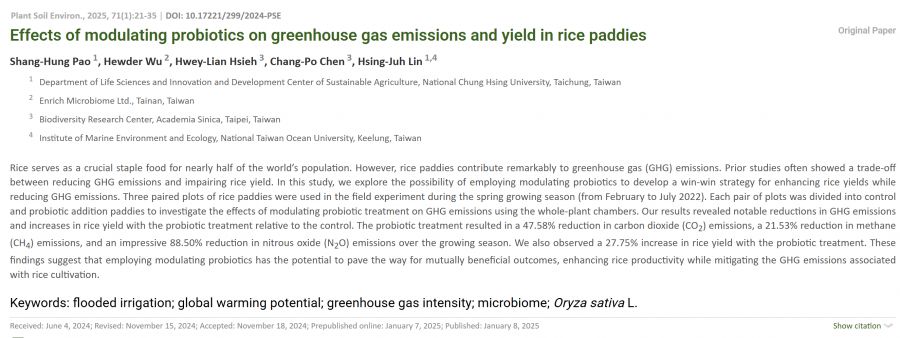
| 論文篇名 | 英文:Effects of modulating probiotics on greenhouse gas emissions and yield in rice paddies 中文:益生菌對於水稻田溫室氣體及收穫量影響 |
| 期刊名稱 | Plant Soil and Environment |
| 發表年份,卷數,起迄頁數 | 2025, 71 (1): 21-35 |
| 作者 | Pao, Shang-hung; Wu, Hewder; Hsieh, Hwey-lian; Chen, Chang-po; Lin, Hsing-juh(林幸助)* |
| DOI | 10.17221/299/2024-PSE |
| 中文摘要 | 米是世界近一半人口的重要主食。然而,稻田對溫室氣體 (GHG) 排放的貢獻很大。先前的研究經常顯示減少溫室氣體排放和損害水稻產量之間需要權衡。在這項研究中,我們探討了利用調節益生菌來開發雙贏策略的可能性,以提高水稻產量,同時減少溫室氣體排放。春季生長季節(2022 年 2 月至 7 月)的田間實驗中使用了三塊成對的稻田。每對地塊被劃分為對照稻田和益生菌添加稻田,以研究使用全株室調節益生菌處理對溫室氣體排放的影響。我們的結果顯示,相對於對照組,益生菌處理的溫室氣體排放量顯著減少,水稻產量增加。益生菌處理使生長季節的二氧化碳 (CO2) 排放量減少了 47.58%,甲烷 (CH4) 排放量減少了 21.53%,一氧化二氮 (N2O) 排放量減少了 88.50%,令人印象深刻。此外,我們觀察到益生菌處理後水稻產量顯著增加了 27.75%。這些發現表明,採用調節益生菌有可能為互惠互利的結果鋪平道路,提高水稻生產力,同時減少與水稻種植相關的溫室氣體排放。 |
| 英文摘要 | Rice serves as a crucial staple food for nearly half of the world's population. However, rice paddies contribute remarkably to greenhouse gas (GHG) emissions. Prior studies often showed a trade-off between reducing GHG emissions and impairing rice yield. In this study, we explore the possibility of employing modulating probiotics to develop a win-win strategy for enhancing rice yields while reducing GHG emissions. Three paired plots of rice paddies were used in the field experiment during the spring growing season (from February to July 2022). Each pair of plots was divided into control and probiotic addition paddies to investigate the effects of modulating probiotic treatment on GHG emissions using the whole-plant chambers. Our results revealed notable reductions in GHG emissions and increases in rice yield with the probiotic treatment relative to the control. The probiotic treatment resulted in a 47.58% reduction in carbon dioxide (CO2) emissions, a 21.53% reduction in methane (CH4) emissions, and an impressive 88.50% reduction in nitrous oxide (N2O) emissions over the growing season. Additionally, we observed a notable 27.75% increase in rice yield with the probiotic treatment. These findings suggest that employing modulating probiotics has the potential to pave the way for mutually beneficial outcomes, enhancing rice productivity while mitigating the GHG emissions associated with rice cultivation. |
| 發表成果與本中心研究主題相關性 | 農業碳匯之估算 |