【學術亮點】Systematic review of risks hidden in VR-based learning environments: Research frameworks and evidence from the literature
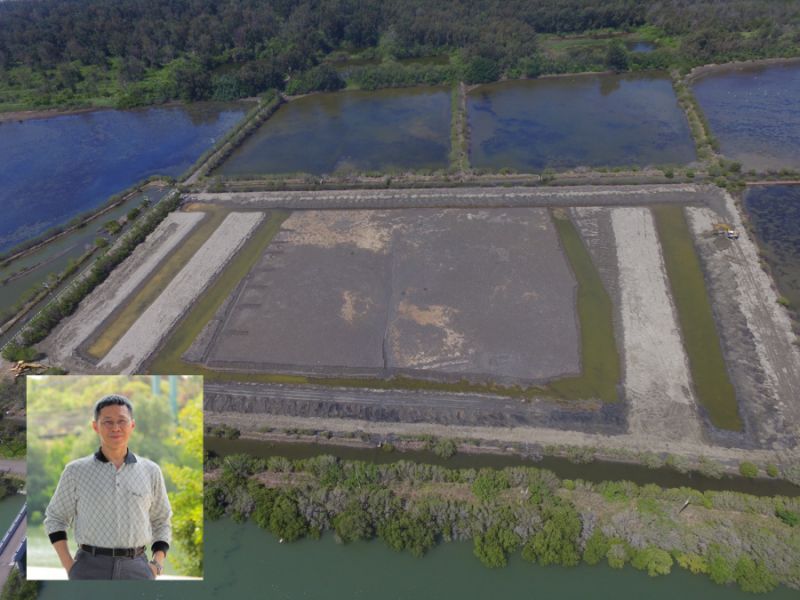
Technological Agriculture: Public Issue Awareness and Regulatory Adaptation for Climate Change【Graduate Institute of Library & Information Science / Tang, Kai-Yu / Associate Professor】
科技農業:氣候變遷的群眾議題熱蒐及法規調適【圖書資訊學研究所/湯凱喻 副教授】
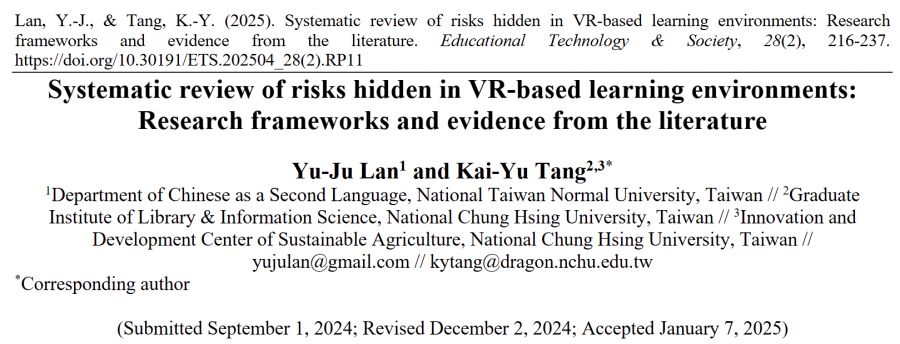
| 論文篇名 | 英文:Systematic review of risks hidden in VR-based learning environments: Research frameworks and evidence from the literature 中文:VR學習環境中隱藏風險的系統性回顧:研究架構與文獻證據 |
| 期刊名稱 | Educational Technology & Society |
| 發表年份,卷數,起迄頁數 | 2025, 28(2), 216-237 |
| 作者 | Lan, Yu-Ju; Tang, Kai-Yu(湯凱喻)* |
| DOI | 10.30191/ETS.202504_28(2).RP11 |
| 中文摘要 | 關於將虛擬實境 (VR) 用於教育的研究正在增加,但大多數現有文獻側重於 VR 對使用者的正面影響,而對其可能產生的負面影響仍未得到充分探索。對負面影響的理解不足可能會使用戶面臨風險。為了彌補這一研究空白,本研究的主要目的是透過對過去十年 (2010-2023) 發表的文獻進行系統性回顧來表徵 VR 使用的負面影響。使用兩組關鍵字搜尋了 Web of Science 和 Scopus。根據 PRISMA,分析了 20 項研究,並在編碼方案的研究分類法中確定了 VR 的五個負面影響類別:身體、心理、認知、行為症狀和網路犯罪。報告 VR 負面影響的出版數量在 2020 年最多,其次是 2023 年、2015 年和 2016 年。資料收集主要採用主觀方法,包括問卷調查和訪談。基於研究結果,我們提出了一系列未來研究的框架:VR成癮、現實與虛擬和諧以及VR導航框架。本文旨在為教育工作者、家長以及未來的研究人員提供一些啟示。 |
| 英文摘要 | Research into the use of virtual reality (VR) for educational purposes is increasing, but most of the existing literature focuses on the positive effects of VR on users, with its possible negative effects remaining underexplored. An inadequate understanding of the negative effects can put users at risk. To address this research gap, the main purpose of this study is to characterize the negative effects of VR use by conducting a systematic review of the literature published in the last decade (2010-2023). Web of Science and Scopus were searched using two sets of keywords. Following PRISMA, 20 studies were analyzed and identified five main categories of negative effects of VR in the research taxonomy of the coding scheme: physical, psychological, cognitive, behavioral symptoms, and cybercrime. The number of publications reporting the negative effects of VR was largest in 2020, followed by 2023, 2015, and 2016. Data were collected mostly using subjective methods, including questionnaire surveys and interviews. Based on the results, a series of frameworks are proposed for future research: VR addiction, reality–virtuality harmony, and VR navigation frameworks. Implications for educators, parents, and future researchers are provided. |
| 發表成果與本中心研究主題相關性 |
|