【學術亮點】Cu/Ni Recovery by Phosphate Crystallization using Fluidized-Bed Homogeneous Crystallization from Electroplating Wastewater
Facility Agricultural: Utilization of Livestock Waste in Automated Cultivation of Microalgae and Reutilization in Poultry Farming【Department of Environmental Engineering / Lu, Ming-Chun / Distinguished Professor】
設施農業:畜牧廢棄物於小球藻自動栽培與禽類再利用【環境工程學系/盧明俊特聘教授】
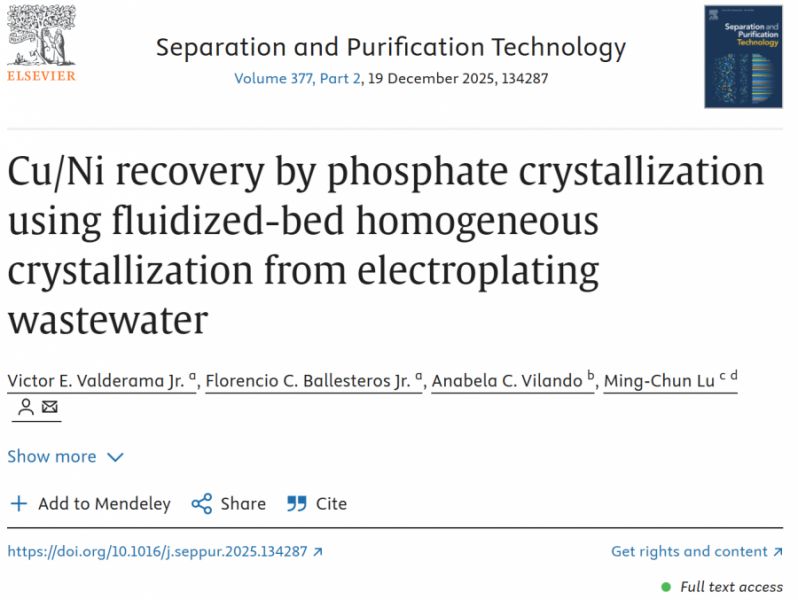
| 論文篇名 | 英文:Cu/Ni Recovery by Phosphate Crystallization using Fluidized-Bed Homogeneous Crystallization from Electroplating Wastewater 中文:應用流體化床均質結晶製程進行銅/鎳磷酸鹽結晶回收技術 |
| 期刊名稱 | Separation and purification Technology |
| 發表年份,卷數,起迄頁數 | 2025, 377, no.134287 |
| 作者 | Valderama Jr, Victor E.; Ballesteros Jr, Florencio C.; Vilando, Anabela C.; Lu, Ming-Chun(盧明俊)* |
| DOI | 10.1016/j.seppur.2025.134287 |
| 中文摘要 | 電鍍產業產生大量含金屬廢水,對資源回收與環境永續構成挑戰。本研究提出一種新穎的磷酸鹽結晶法,可同時回收電鍍廢水中的銅離子([Cu²⁺])與鎳離子([Ni²⁺]),並透過兩種系統——批次結晶(BC)與流體化床均質結晶製程(FBHCP)——提供實用的預處理與資源回收策略。研究探討pH值(6.5–9.5)、磷酸鹽與金屬莫耳比(1.0–2.0)及進流水速率對去除效率與晶體形成的影響。以模擬實際電鍍廢水濃度([Cu²⁺] 152.5 mg/L、[Ni²⁺] 200.95 mg/L)為起點,FBHCP在最佳條件(pH 8.0、莫耳比1.5、流速10.5 mL/min)下達成超過99.9%的去除率。BC系統中殘留濃度分別為[Cu²⁺] 7.63 mg/L與[Ni²⁺] 10.0 mg/L,而FBHCP僅為[Cu²⁺] 0.15 mg/L與[Ni²⁺] 0.20 mg/L。透過XRD、SEM與EDS鑑定晶體,FBHCP所產晶體較大且純度更高,70%以上尺寸超過0.7 mm,且產泥量較少。本研究首度證實磷酸鹽基FBHCP可同時回收[Cu²⁺]與[Ni²⁺],具高效去除、低污泥產生與可擴展性,並符合循環經濟原則,促進工業廢水中金屬的高效回收與再利用。 |
| 英文摘要 | The electroplating industry generates significant amounts of metal-laden wastewater, posing challenges for resource recovery and environmental sustainability. This study presents a novel phosphate-based crystallization method for simultaneously recovering copper [Cu2+] and nickel [Ni2+] from electroplating wastewater, offering a practical strategy for pretreatment and resource recovery using two systems: batch crystallization (BC) and fluidized-bed homogeneous crystallization process (FBHCP). This study aimed to examine the effects of pH (6.5–9.5), phosphate-to-metal ([PO4−3]/[metals]) molar ratio (MR) (1.0–2.0), and influent flow rate on removal efficiency and crystal formation. Starting with 152.5 mg·L−1 [Cu2+] and 200.95 mg·L−1 [Ni2+] simulated based on the actual electroplating wastewater, FBHCP achieved >99.9 % removal under optimal conditions (pH 8.0, MR 1.5, IFR 10.5 mL/min). The average residual concentration of [Cu2+] was 7.63 mg·L−1 and 10.0 mg·L−1 for [Ni2+] in a BC process, while in the FBHCP, the [Cu2+] remaining was 0.15 mg·L−1 and 0.20 mg·L−1 for [Ni2+]. Characterization through XRD, SEM, and EDS: the crystals were compared to BC; FBHCP produced larger, purer crystals, with over 70 % exceeding 0.7 mm, and generated less sludge. This study is the first to demonstrate a phosphate-based FBHCP for the simultaneous recovery of [Cu2+] and [Ni2+] from electroplating wastewater, achieving high removal efficiency, reduced sludge, and scalable, crystal-based metal recovery aligned with circular economy principles by enabling efficient metal recovery and reuse from industrial effluents. |
| 發表成果與本中心研究主題相關性 | 本研究所提出之磷酸鹽基流體化床均質結晶製程(FBHCP),雖針對電鍍廢水中銅與鎳離子進行回收,但其技術原理與操作參數亦可延伸應用於畜牧廢水中營養源(如氮與磷)的回收。FBHCP具備高去除率、低污泥產生與可擴展性,可促進磷酸銨鎂(MAP)等肥料型晶體的形成,實現畜牧廢水中氮磷資源的高值化利用。此技術不僅提升廢水處理效率,亦符合循環經濟與永續農業發展目標。 |