【學術亮點】Key factors in the continuance of self-service technology and its mobile app adoption-A case study of convenience stores in Taiwan
Technological Agriculture: Public Issue Awareness and Regulatory Adaptation for Climate Change【Graduate Institute of Library & Information Science / Tang, Kai-Yu / Associate Professor】
科技農業:氣候變遷的群眾議題熱蒐及法規調適【圖書資訊學研究所/湯凱喻 副教授】
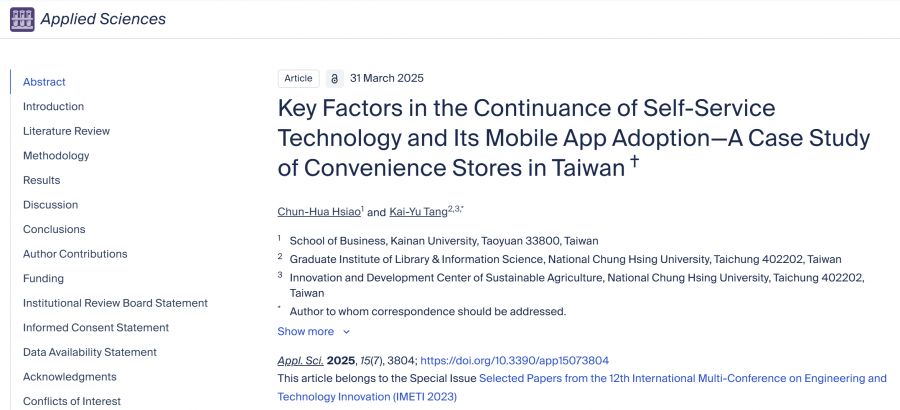
| 論文篇名 | 英文:Key factors in the continuance of self-service technology and its mobile app adoption-A case study of convenience stores in Taiwan 中文:自助服務科技與手機應用程式持續應用的關鍵因素-以台灣便利商店為例 |
| 期刊名稱 | Applied Sciences-Basel |
| 發表年份,卷數,起迄頁數 | 2025, 15(7), no. 3804 |
| 作者 | Hsiao, Chun-Hua; Tang, Kai-Yu(湯凱喻)* |
| DOI | 10.3390/app15073804 |
| 中文摘要 | 過往文獻主張透過線下到線上和線上到線下模式整合管道。然而,很少有研究調查這兩個管道之間的相互關係。本研究借鑒自助服務技術 (SST) 和期望-確認理論的文獻,旨在研究 SST 的關鍵屬性,並評估其對線下到線上和線上到線下通路消費者評估的影響。在便利商店進行問卷調查,並透過實體自助服務亭收集 360 位使用者回覆。使用具有線性結構關係的兩階段結構方程模型 (LISREL 8.54) 軟體進行資料分析。實證結果驗證了實體 SST(實體系統的服務品質和感知便利性)和線上 SST(虛擬系統的服務品質和感知普遍性)的屬性是滿意度和態度以及隨後對每個管道的行為意圖的關鍵前因。然而,從線下(實體自助服務終端使用)到線上(自助服務終端應用採用)意圖的一些過渡效應並不像假設的那樣顯著。感知便利性和滿意度等離線屬性對線上自助服務終端(自助服務終端應用)沒有顯著影響,除了實體系統的服務品質。本文提供了討論和啟示,包括簡潔功能設計和基本自助服務終端服務的策略。 |
| 英文摘要 | Past literature has advocated the integration of channels through the offline-to- online and online-to-offline models. However, little research has investigated the interrelationships effects between the two channels. Drawing on the literature from self-service technology (SST) and expectation–confirmation theory, this study aims to investigate key attributes of SST and assess their impact on consumer evaluations across offline-to-online and online-to-offline channels. A questionnaire survey was administered at convenience stores, and 360 user responses were collected through a physical self-service kiosk. Two-stage structural equation modeling with linear structural relations (LISREL version 8.54) software was used for data analysis. The empirical results verified the attributes of physical SST (physical system’s service quality and perceived convenience) and online SST (virtual system’s service quality and perceived ubiquity) as critical antecedents of satisfaction and attitude and the subsequent behavioral intentions toward each channel. However, some transitional effects from offline (physical kiosk use) to online (kiosk app adoption) intention were not as significant as hypothesized. The offline attributes of perceived convenience and satisfaction had no significant impact on online SST significantly (kiosk app), except for the physical system’s service quality. Discussions and implications are provided, including strategies for concise functional design and essential SST services. |
| 發表成果與本中心研究主題相關性 |
|