Recycling Agriculture: Valorization of Agricultural Residual Materials【Department of Environmental Engineering / Lin, Kun-Yirew / Distinguished Professor】
循環農業:農業剩餘資材及生質衍生物高值化轉換再利用【環境工程學系/林坤儀特聘教授】
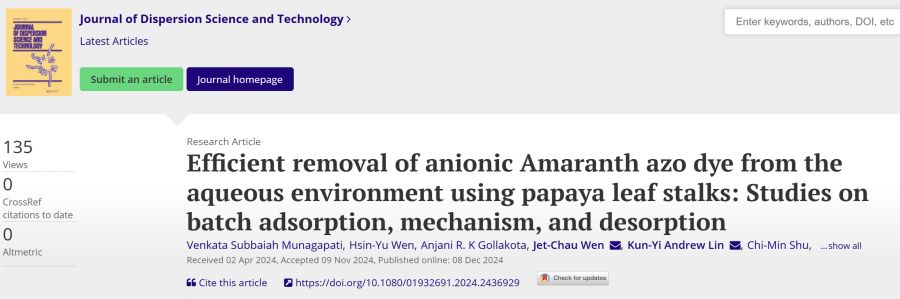
| 論文篇名 | Efficient removal of anionic Amaranth azo dye from the aqueous environment using papaya leaf stalks: Studies on batch adsorption, mechanism, and desorption |
| 期刊名稱 | Journal of Dispersion Science and Technology |
| 發表年份,卷數,起迄頁數 | 2024 |
| 作者 | Munagapati, Venkata Subbaiah; Wen, Hsin-Yu; Gollakota, Anjani R. K.; Wen, Jet-Chau; Lin, Kun-Yi Andrew(林坤儀)*; Shu, Chi-Min; Yarramuthi, Vijaya; Basivi, Praveen Kumar; Kim, Chang Woo; Tang, Jeung-Tai |
| DOI | 10.1080/01932691.2024.2436929 |
| 英文摘要 | Papaya leaf stalks (PLS) were utilized in the current research to eliminate Amaranth (AM) dye from an aqueous medium. PLS was characterized through various techniques, including BET/BJH, pHPZC, XRD, FTIR, FESEM, and EDX. The FTIR analysis unveiled that -OH (hydroxyl), -C=O (carbonyl), and -COOH (carboxylic) groups were involved in binding AM to the surface of PLS. Batch mode adsorption tests were conducted, and various operational variables like pH, the mass of PLS, AM dye concentration, contact duration, stirring speed, temperature, and regeneration of the PLS were investigated. The maximal AM removal efficiency of 91.1 ± 2.601% was observed at pH 2.0. The pHPZC of the PLS was determined to be 5.5. The experiment results were analyzed using isotherm models (Freundlich, Temkin and Langmuir) and kinetic models (pseudo-second-order and pseudo-first-order). The pseudo-second-order kinetic and Langmuir isotherm models provided the best fit. The maximal sorption uptake of AM dye on PLS was achieved at 121.3 ± 1.493 mg/g at 298 K. The thermodynamic variables indicated that the sorption process was spontaneous (ΔGo < 0), exothermic (ΔHo > 0), and feasible (ΔSo > 0) at different temperatures. The AM adsorption on PLS was mainly due to electrostatic interactions. Desorption tests were also carried out to investigate the feasibility of regenerating PLS, and 89.2 ± 1.184% of the adsorbed AM was recovered using 0.2 M-NaOH. The reusability results indicated that 76.9 ± 2.204% of the adsorption efficiency could still be maintained even after six cycles. These results demonstrate that PLS is an environmentally friendly and suitable material for removing AM from wastewater. |
| 發表成果與本中心研究主題相關性 | 透過本研究可進一步建立開發本研究計算所需之觸媒材料,並釐清可適合應用之環境條件! |