【學術亮點】Machine Learning-assisted Optimization Design for Enhanced Oxygen Evolution Reaction Based on Vanadium-doped Nickel-Cobalt Layered Double Hydroxides
Facility Agricultural: Green Energy Development and Carbon Offset【Department of Chemical Engineering / Chen, Chih-Ming/ Distinguished Professor】
設施農業:農業綠能開發與碳匯補償【化學工程學系陳志銘 特聘教授】
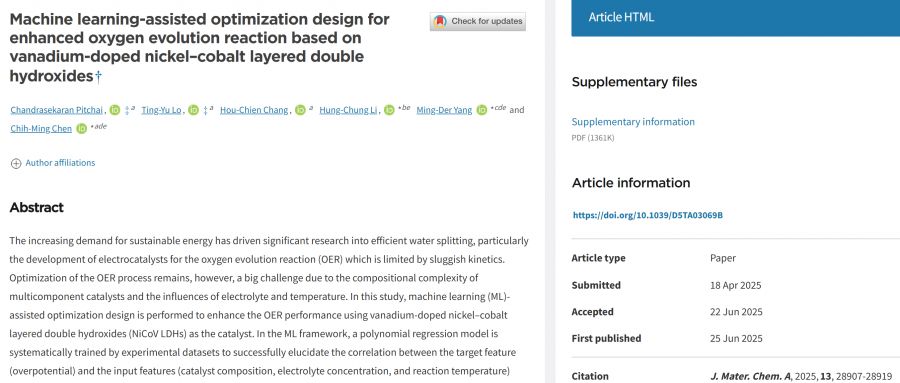
| 論文篇名 | 英文:Machine Learning-assisted Optimization Design for Enhanced Oxygen Evolution Reaction Based on Vanadium-doped Nickel-Cobalt Layered Double Hydroxides 中文:基於釩摻雜鎳鈷層狀雙氫氧化物的強化析氧反應的機器學習輔助優化設計 |
| 期刊名稱 | Journal of Materials Chemistry A |
| 發表年份,卷數,起迄頁數 | 2025, 13, 28907-28919 |
| 作者 | Pitchai, Chandrasekaran; Lo, Ting-Yu; Chang, Hou-Chien; Li, Hung-Chung; Yang, Ming-Der(楊明德)*; Chen, Chih-Ming(陳志銘)* |
| DOI | 10.1039/D5TA03069B |
| 中文摘要 | 對可持續能源日益增長的需求推動對高效水分解的大量研究,特別是針對受緩慢動力學限制的析氧反應的電催化劑的開發。然而,由於多組分催化劑的成分複雜性以及電解質和溫度的影響,析氧反應過程的最佳化仍然是一個巨大的挑戰。在本研究中,使用釩摻雜的鎳鈷層狀雙氫氧化物作為催化劑,進行機器學習輔助優化設計,以提高析氧反應性能。在機器學習框架下,透過實驗資料集系統地訓練多項式迴歸模型,以成功闡明目標特徵(過電位)與輸入特徵(催化劑成分、電解質濃度和反應溫度)之間的相關性,其判定係數高達 0.842。基於機器學習演算法預測的最佳化輸入特徵,實驗獲得了196 mV的優異過電位,與原始訓練資料集中的最佳催化性能(238 mV)相比降低了21%。結構和電化學特性證實了優化後的電催化劑具有清晰的層狀結構和高效的電荷轉移動力學。我們的研究成果對於將機器學習演算法與實驗合成結合,合理設計和優化高性能、經濟高效的析氧反應電催化劑具有重要的里程碑意義。 |
| 英文摘要 | The increasing demand for sustainable energy has driven significant research into efficient water splitting, particularly the development of electrocatalysts for the oxygen evolution reaction (OER) which is limited by sluggish kinetics. Optimization of the OER process remains, however, a big challenge due to the compositional complexity of multicomponent catalysts and the influences of electrolyte and temperature. In this study, machine learning (ML)-assisted optimization design is performed to enhance the OER performance using vanadium-doped nickel–cobalt layered double hydroxides (NiCoV LDHs) as the catalyst. In the ML framework, a polynomial regression model is systematically trained by experimental datasets to successfully elucidate the correlation between the target feature (overpotential) and the input features (catalyst composition, electrolyte concentration, and reaction temperature) with a high coefficient of determination (R2) of 0.842. Based on the optimized input features predicted by the ML algorithm, a superior overpotential of 196 mV is experimentally obtained which is reduced by 21% compared to the best catalytic performance (238 mV) in the original training datasets. Structural and electrochemical characterizations confirm a well-defined layered morphology and efficient charge transfer dynamics for the optimized electrocatalyst. Our results stand as a significant milestone for integrating an ML algorithm with experimental synthesis for the rational design and optimization of high-performance, cost-effective OER electrocatalysts.LDH@NiCoS/NF as a crucial breakthrough in research on bifunctional electrocatalysts for the HER and the OER, presenting a hopeful direction for harnessing renewable energy from seawater. |
| 發表成果與本中心研究主題相關性 | 電解水產氫是可再生能源的重要發展策略,是提供設施農業自主能源供給的可行方向之一。 |