【學術亮點】Assessing tourism pressure on wildlife in a protected area: A social big data approach using photo-sharing data and species distribution modeling
Ecological Agriculture: Assessment of Forest Carbon Sink and Ecological Economy under Climate Change【 Department of Forestry / Liu, Wan-Yu / Distinguished Professor】
生態農業:氣候變遷下森林碳匯與生態經濟評估【森林學系/柳婉郁特聘教授】
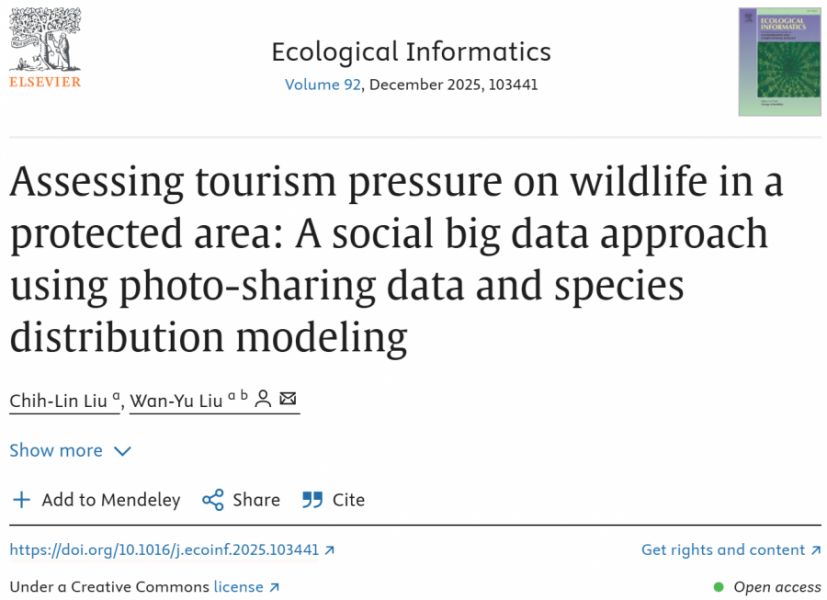
| 論文篇名 | 英文:Assessing tourism pressure on wildlife in a protected area: A social big data approach using photo-sharing data and species distribution modeling 中文:評估旅遊對保護區野生動物的壓力:使用照片共享資料和物種分佈模型的社會大數據方法 |
| 期刊名稱 | Ecological Informatics |
| 發表年份, 卷數,起迄頁數 | 2025, 92, no.103441 |
| 作者 | Liu, Chih-Lin; Liu, Wan-Yu(柳婉郁)* |
| DOI | 10.1016/j.ecoinf.2025.103441 |
| 中文摘要 | 保護區在維持生物多樣性保育與自然旅遊壓力之間,正面臨日益嚴峻的挑戰。本研究建立地理空間明確的分析框架,結合社會數據分析與物種分布模型(Species Distribution Modeling, SDM),以評估台灣雪霸國家公園之旅遊活動所造成的生態壓力。本研究蒐集49種受保護陸域脊椎動物之潛在分布範圍資料,並篩選其中與園區潛在分布區域重疊的16種列於國際自然保護聯盟(IUCN)紅皮書中的受保護物種。研究共分析2914個空間網格(500 × 500 公尺),並利用2008年至2017年間上傳至 Flickr 平台之地理標記照片,計算每月的「照片使用者日數」(Photo-User-Days, PUD)。分析結果顯示,每月PUD 值與官方遊客統計量之間具有高度相關(r = 0.818,p = 0.001),驗證其在季節性分析上的可靠性。透過核心密度估計方法與迴歸分析發現,尤其是遊客中心(估計值 = 2.0160)與旅館(估計值=1.6550)之基礎設施變數,為旅遊壓力的最強預測因子(Adjusted R² = 0.3568),而河川則未顯示顯著影響。空間疊加分析結果顯示,高遊憩使用密度值(PUD)與一級保育類物種(如紅胸鴝 Passer rutilans、石虎 Prionailurus bengalensis chinensis) 的預測棲地高度重疊,主要集中於園區東部地區,包括一般保護區與保育區。季節性圓統計分析顯示遊憩活動呈雙峰分佈,分別於二月及十一至十二月達到高峰(Rayleigh Z = 5.72,p < 0.01),而五月的訪客量最低。PUD 指數介於 0(最低) 至 35.2 (最高) 之間,中位數約為 0.16。此一季節性趨勢顯示,在淡季實施遊客進入管制具有潛在價值。遊憩壓力在偏遠且高海拔的保育區最低,而此類區域往往為敏感物種的棲息地。本研究依據棲地適宜性與旅遊壓力的空間疊加結果,識別出四類保育風險區域:LL、LH、HL 與 HH。進一步分析發現,HH 區域(即高生態價值且高遊憩壓力區)集中於園區東部,約占園區總面積的 6%。此類區域為生物多樣性衝突最為嚴重的熱點,對未來分區管理、季節性入園管制及遊客分流策略之制定,具有關鍵參考價值。本研究透過開放取用之社群媒體資料與生態模型的操作應用,支援豐富生物多樣性保護區的適應性管理。 |
| 英文摘要 | Protected areas face growing challenges in balancing biodiversity conservation with the pressures of nature-based tourism. This study develops a geospatially explicit framework integrating social big data analytics and species distribution modeling (SDM) to assess tourism-induced ecological stress in Shei-Pa National Park, Taiwan. We used datasets on the potential distribution range of 49 protected terrestrial vertebrate species. We selected 16 protected species on the IUCN Red List whose potential distributions overlapped with the park. We analyzed 2914 spatial grids (500 × 500 m) using photo-user-days (PUD) derived from geotagged photographs uploaded to the Flickr platform (2008–2017). The monthly PUD values were strongly correlated with official visitor statistics (r = 0.818, p = 0.001), validating their reliability for seasonal analysis. Kernel density estimation and regression analyses revealed that infrastructure variables—particularly visitor centers (estimate = 2.0160) and hotels (1.6550)—were the strongest predictors of tourism pressure (Adjusted R2 = 0.3568), while rivers showed no effect. Spatial overlay analysis revealed that high PUD values strongly overlapped with the predicted habitats of Level 1 protected species (e.g., Passer rutilans, Prionailurus bengalensis chinensis), especially in the eastern region of the park, including a Generally Protected Area and a Conservation Area. Seasonal circular statistics revealed a bimodal tourism pattern, peaking in February and in November–December (Rayleigh Z =5.72, p <0.01), with minimal visitation in May. The PUD index ranged from 0 (minimum) to 35.2 (maximum), with a median value of approximately 0.16. This seasonal trend highlights the potential value of implementing visitor access controls during off-peak months. Tourism pressure was lowest in remote, high-altitude conservation zones, which often harbor sensitive species. We identified four conservation risk zones-LL, LH, HL, and HH-based on spatial overlays of habitat suitability and tourism pressure. Note that HH zones, indicating high ecological value and high tourism pressure, were concentrated in the eastern region of the park and accounted for approximately 6 % of its total area. These areas represent the most critical zones for biodiversity conflict and inform targeted zoning, seasonal access control, and visitor redistribution strategies. This study operationalizes open-access social media data and ecological modeling to support the adaptive management of biodiversity-rich protected areas. |
| 發表成果與本中心研究主題相關性 | 符合研究主題:生態農業。 此研究主要為社會科學研究,可促進農企業與農林生態旅遊之永續發展。 |