【學術亮點】Anaerobic Fe(II) bio-oxidation by Cyanidiophyceae to enhance As(III) removal: a novel and efficient biological material toward resilient remediation
Ecological Agriculture: Optimization and Validation of Soil Carbon Sequestration Prediction Models【Department of Soil Environmental Sciences / Tzou, Yu-Min / Distinguished Professor、Liu, Yu-Ting / Distinguished Professor】
生態農業:土壤碳蓄存之預測模型優化及驗證【土壤環境科學系/鄒裕民特聘教授、劉雨庭特聘教授】
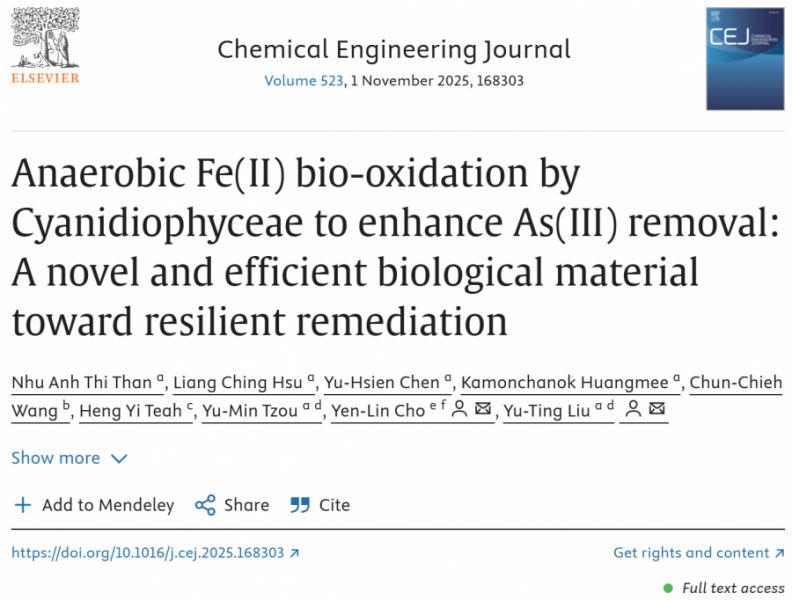
| 論文篇名 | 英文:Anaerobic Fe(II) bio-oxidation by Cyanidiophyceae to enhance As(III) removal: a novel and efficient biological material toward resilient remediation 中文:厭氧條件下溫泉紅藻促進 Fe(II) 的生物氧化作用增加 As(III) 去除:新穎高效的生物材料用於環境修復 |
| 期刊名稱 | Journal of Agricultural and Food Chemistry |
| 發表年份,卷數,起迄頁數 | 2025, 523, no. 168303 |
| 作者 | Than, Nhu Anh Thi; Hsu, Liang Ching; Chen, Yu-Hsien; Huangmee, Kamonchanok; Wang, Chun-Chieh; Teah, Heng Yi; Tzou, Yu-Min(鄒裕民); Cho, Yen-Lin; Liu, Yu-Ting(劉雨庭)* |
| DOI | 10.1016/j.cej.2025.168303 |
| 中文摘要 | 在缺氧環境中,砷(As)的溶解與鐵(Fe)循環息息相關。三價鐵 [Fe(III)] 在缺氧條件下易被還原為二價鐵 [Fe(II)],進而釋放砷至地下水並加劇污染。本研究針對溫泉紅藻(Cyanidiophyceae)在缺氧條件下的氧化能力進行探討,旨在開發新型 Fe(II)改質生物材料 ,以提升亞砷酸鹽 [As(III)] 的去除效率。實驗結果顯示,將 Cyanidium caldarium (Cc) 與 Galdieria partita (Gp) 進行 Fe(II) 改質後,兩者均能將吸附的 Fe(II) 超過 96.8% 轉化為 Fe(III)。此改質大幅提升了 As(III) 的吸附量,分別為未改質藻類的 1.4 倍與 1.6 倍,達到 167.8 與 141.2 mg g−1。同步輻射光譜分析進一步顯示:Cc 主要透過細胞內解毒作用,形成 As(III)-半胱氨酸 [As(III)-cys] 複合物;而 Gp 則在厭氧環境中更具優勢,能將 As(III) 氧化為毒性較低的砷酸鹽 [As(V)],並由表面多醣固定。值得注意的是,在 Fe(II) 厭氧生物氧化過程中生成並隨後老化的 Fe(III) 氫氧化物,進一步顯著提升了兩者對 As(III) 的去除能力。綜上所述,本研究結果凸顯 Cc 與 Gp 在富鐵區域砷污染環境中的應用潛力,展現出作為綠色且具韌性的生物修復策略的前景。 |
| 英文摘要 | In anaerobic environments, arsenic (As) dissolution is closely tied to iron (Fe) cycling. Ferric iron [Fe(III)] is reduced to ferrous iron [Fe(II)] under anaerobic conditions, releasing As into groundwater and worsening contamination. This study explored the anaerobic oxidation capabilities of Cyanidiophyceae to develop novel Fe(II)-loaded biomaterials for efficient arsenite [As(III)] removal. Cyanidium caldarium (Cc) and Galdieria partita (Gp) were first loaded with Fe(II), with both species converting over 96.8 % of sorbed Fe(II) to Fe(III). As(III) sorption amounts on Fe-loaded Cc and Gp were 1.4 and 1.6 times greater than those absorbed on their unmodified counterparts, reaching 167.8 and 141.2 mg g−1, respectively. Synchrotron-based analyses revealed that Cc primarily utilized intracellular detoxification via the formation of As(III)-cysteine [As(III)-cys] complexes, whereas Gp excelled in oxidizing As(III) to less toxic arsenate [As(V)], particularly in anaerobic environments, where it was subsequently sequestered by surface polysaccharides. The Fe(III) hydroxides formed through anaerobic Fe(II) bio-oxidation and aged during As(III) sorption significantly enhanced As(III) uptake in both species. These findings highlight the potential of Cc and Gp for the green and resilient bioremediation of As-contaminated environments, especially in Fe-rich areas. |
| 發表成果與本中心研究主題相關性 | 此研究與永續農業創新發展中心的高度相關性,在於其對 砷污染復育與環境保護 的創新貢獻。研究指出,在缺氧環境中,溫泉紅藻綱(Cyanidiophyceae)具備獨特的 Fe(II) 生物氧化能力,能有效提升亞砷酸鹽 [As(III)] 的去除效率。特別是 Cyanidium caldarium (Cc) 與 Galdieria partita (Gp) 不僅能高效轉化 Fe(II) 為 Fe(III),還展現出細胞內解毒與氧化轉化 As(III) 的雙重機制,大幅減輕了砷對土壤與水環境的危害。這種以天然藻類為基礎的 綠色解決方案,契合永續農業強調的環境友善與資源永續利用理念。相較於傳統依賴化學藥劑的治理方式,本研究展現出更低衝擊、更具韌性的修復途徑,不僅提升了農業生產中土壤與水質的安全性,也為農業面臨的污染復育問題提供了前瞻性的技術藍圖。綜合而言,本研究顯示的砷去除與解毒新機制,不僅推動了污染治理科技的創新,更與永續農業創新發展中心追求的創新、低碳與永續目標高度符合,為未來農業與環境保護的共同發展提供了強力的科學基礎。 |