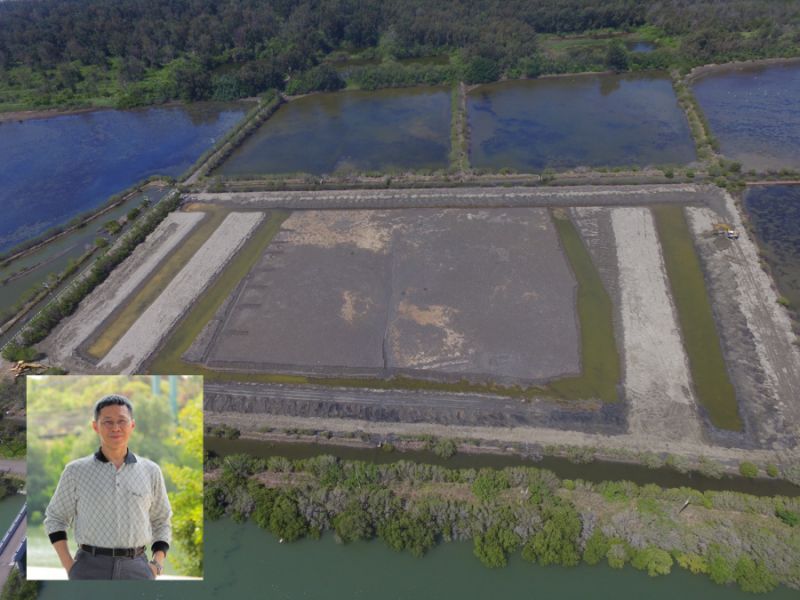
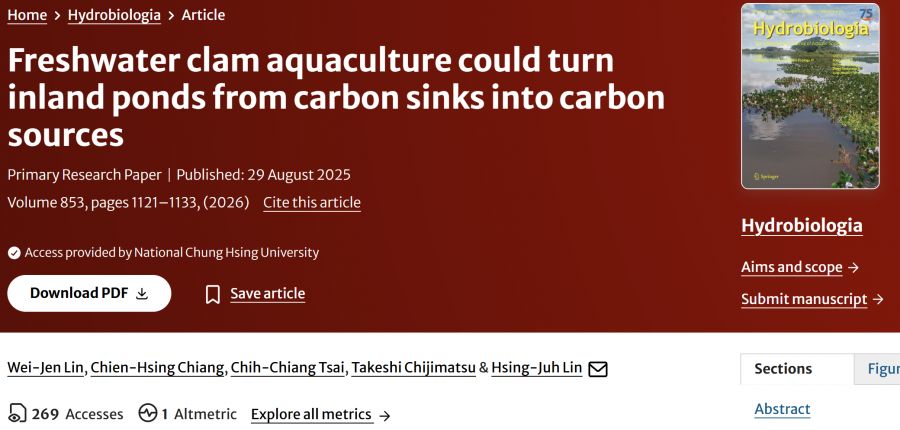
【學術亮點】Freshwater clam aquaculture could turn inland ponds from carbon sinks into carbon sources
Ecological Agriculture: Nature-Based Solutions for Restoring Wetland Carbon Sink under Climate Change【Department of Life Sciences / Lin, Hsing-Juh / Distinguished Professor】
生態農業:氣候變遷下以自然為本之濕地碳匯復育策略【生命科學系/林幸助特聘教授】
| 論文篇名 | 英文:Freshwater clam aquaculture could turn inland ponds from carbon sinks into carbon sources 中文:淡水貝類養殖能將魚塭碳匯轉為碳源 |
| 期刊名稱 | Hydrobiologia |
| 發表年份,卷數,起迄頁數 | 2026, 853, 1121-1133 |
| 作者 | Lin, Wei-Jen; Chiang, Chien-Hsing; Tsai, Chih-Chiang; Chijimatsu, Takeshi; Lin, Hsing-Juh(林幸助)* |
| DOI | 10.1007/s10750-025-05984-1 |
| 中文摘要 | 內陸水域僅覆蓋全球表面積的一小部分。然而,高碳埋藏率可能會導致內陸濕地的碳匯。最近,許多內陸水域已轉變為淡水養殖,以滿足不斷增長的人口不斷增長的糧食需求。然而,這些淡水養殖池塘碳平衡的變化尚未得到研究。在這項研究中,我們建立了台灣東部有和沒有亞洲蛤蜊 (黃金蜆) 養殖的淡水池塘的原位碳收支。所有蛤蜊養殖池都充當碳源(0.109 至 0.188 g C m-2 d-1),而沒有蛤蜊的池塘充當碳匯(-0.378 g C m-2 d-1)。碳平衡的這種變化可能歸因於殼通過鈣化生長導致的二氧化碳外流。本研究首次提出了淡水養殖池塘的碳收支,可進一步應用於其他養殖動物,以更加了解水產養殖對內陸水域碳平衡的影響。 |
| 英文摘要 | Inland waters cover only a small fraction of the global surface area. However, high carbon burial rates can potentially contribute to the carbon sinks of inland wetlands. Recently, many inland waters have been converted to freshwater aquaculture to meet the rising food demand of a growing human population. However, the changes in the carbon balance of these freshwater aquaculture ponds have not been examined. In this study, we constructed in situ carbon budgets for freshwater ponds with and without Asian clam (Corbicula fluminea) culture in eastern Taiwan. All the clam culture ponds acted as carbon sources (0.109 to 0.188 g C m-2 d-1), whereas the pond without clams acted as a carbon sink (-0.378 g C m-2 d-1). This shift in the carbon balance may be attributed to CO2 efflux resulting from shell growth via calcification. This study presents the first carbon budget for freshwater aquaculture ponds, which can be further applied to other farming animals to better understand the impact of aquaculture on the carbon balance of inland waters. |
| 發表成果與本中心研究主題相關性 | 農業碳匯之估算 |