
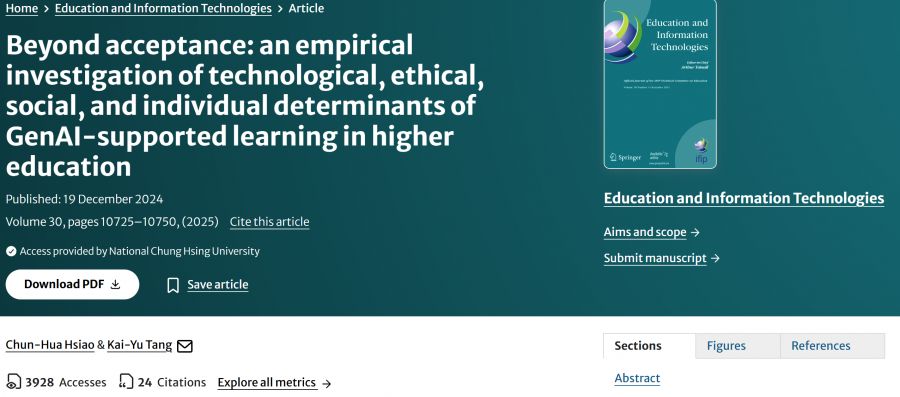
【學術亮點】Beyond acceptance: an empirical investigation of technological, ethical, social, and individual determinants of GenAI-supported learning in higher education
Technological Agriculture: Public Issue Awareness and Regulatory Adaptation for Climate Change【Graduate Institute of Library & Information Science / Tang, Kai-Yu / Associate Professor】
科技農業:氣候變遷的群眾議題熱蒐及法規調適【圖書資訊學研究所/湯凱喻 副教授】
| 論文篇名 | 英文:Beyond acceptance: an empirical investigation of technological, ethical, social, and individual determinants of GenAI-supported learning in higher education 中文:超越接受:高等教育中生成式人工智慧輔助學習之技術、倫理、社會與個人決定因素的實證研究 |
| 期刊名稱 | Education and Information Technologies |
| 發表年份,卷數,起迄頁數 | 2025, 30(8), 10725-10750 |
| 作者 | Hsiao, Chun-Hua; Tang, Kai-Yu(湯凱喻)* |
| DOI | 10.1007/s10639-024-13263-0 |
| 中文摘要 | ChatGPT 等生成式人工智慧 (GenAI) 的快速發展為其在教育領域的應用既帶來了機遇,也帶來了挑戰。一些教育工作者擔心,人工智慧會如此快速地產生報告可能會鼓勵作弊或阻礙學生批判性思考能力的發展。除了單純的接受之外,我們提出了一個基於技術接受模型 (TAM) 和規範激活模型 (NAM) 的綜合模型,以檢驗學習者在高等教育中使用 GenAI 支持的學習應用程序的行為意向的技術、倫理、社會和個人決定因素。透過線上調查共收集了來自台灣大學生的 336 份實際用戶回复,並使用 LISREL 8.54 的結構方程模型來檢驗從 TAM-NAM 模型得出的假設。結果表明,感知有用性、易用性和趣味性(技術因素)顯著影響大學生參與 GenAI 支援的學習應用程式的意願,證實了文獻中關於技術重要性的發現。對後果的意識對個人規範(道德因素)有正向影響,但對行為意圖有負向影響;然而,個人規範和主觀規範(社會因素)並不顯著。這項發現為學術誠信文獻提供了證據,並反映了大學生在使用 GenAI 進行學習時如何考慮道德問題。此外,我們發現個人創新能力和自我效能是大學生採用 GenAI 支援的學習應用程式的重要個人因素。基於提出的 TAM-NAM 模型,結果強調了在考慮道德考量和個人動機的同時考慮技術優勢的重要性。並提供了討論和啟示。 |
| 英文摘要 | The rapid development of generative AI (GenAI), such as ChatGPT, has created both opportunities and challenges for its use in education. Some educators have expressed concern that such rapid report generation from AI may encourage cheating or hinder the development of critical thinking skills in students. Moving beyond mere acceptance, we propose an integrated model based on the technology acceptance model (TAM) and the norm activation model (NAM) to examine the technological, ethical, social, and individual determinants of learners’ behavioral intentions to use GenAI-supported learning applications in higher education. A total of 336 actual user responses from college students in Taiwan were collected through an online survey, and structural equation modeling using LISREL 8.54 was used to test the proposed hypotheses derived from the TAM-NAM model. The results show that perceived usefulness, ease of use, and enjoyment (technological factors) significantly influence college students’ intention to engage in GenAI-supported learning applications, confirming findings of technological importance from the literature. Awareness of consequences positively influences personal norms (ethical factors) but negatively influences behavioral intentions; however, personal norms and subjective norms (social factors) are not found to be significant. This finding adds evidence to the academic integrity literature and reflects how college students consider ethical issues when using GenAI for learning. In addition, we found that personal innovativeness and self-efficacy are significant individual factors for college students’ adoption of GenAI-supported learning applications. Based on the proposed TAM-NAM model, the results highlight the importance of considering technological benefits alongside ethical considerations and individual motivations. Discussion and implications are provided. |
| 發表成果與本中心研究主題相關性 |
|