【學術亮點】Adsorptive removal of uranium(VI) from aqueous solutions using amine-modified chitosan: Kinetics, isotherms, thermodynamics, and its mechanistic insights
Recycling Agriculture: Valorization of Agricultural Residual Materials【Department of Environmental Engineering / Lin, Kun-Yirew / Distinguished Professor】
循環農業:農業剩餘資材及生質衍生物高值化轉換再利用【環境工程學系/林坤儀特聘教授】
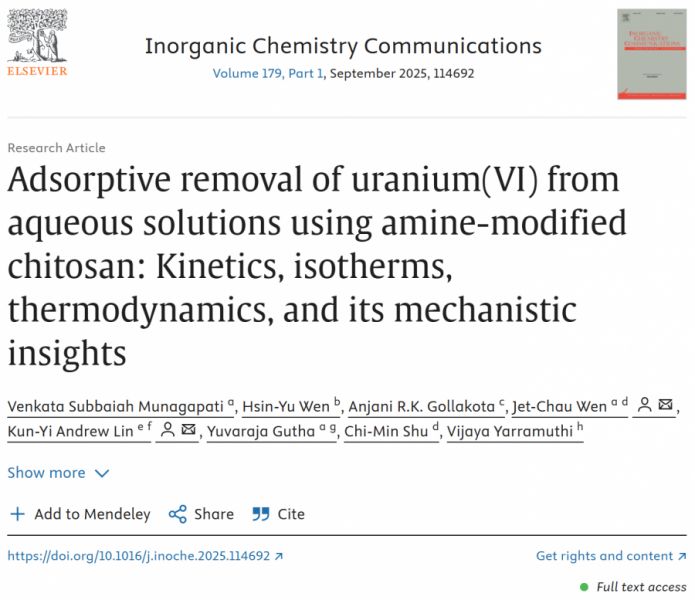
| 論文篇名 | 英文:Adsorptive removal of uranium(VI) from aqueous solutions using amine-modified chitosan: Kinetics, isotherms, thermodynamics, and its mechanistic insights 中文:利用胺改質殼聚醣從水溶液中吸附去除鈾(VI):動力學、等溫線、熱力學及其機制見解 |
| 期刊名稱 | Inorganic Chemistry Communications |
| 發表年份,卷數,起迄頁數 | 2025,179, no.114692 |
| 作者 | Munagapati, Venkata Subbaiah; Wen, Hsin-Yu; Gollakota, Anjani R. K.; Wen, Jet-Chau; Lin, Kun-Yi Andrew(林坤儀)*; Gutha, Yuvaraja; Shu, Chi-Min; Yarramuthi, Vijaya |
| DOI | 10.1016/j.inoche.2025.114692 |
| 中文摘要 | 工業核廢料中鈾釋放至水體環境,對生態系統與環境平衡構成了嚴重威脅。因此,開發具高吸附能力、低成本且環境友善的生物吸附劑,以去除液相中 U(VI) 污染物,具有重要意義。 在本研究中,我們透過多步化學改質法成功合成了一種新型的胺基改質幾丁聚醣(AMCS)吸附劑。該方法包括氯化反應、席夫鹼(Schiff base)生成**及後續胺化修飾步驟,用以提升材料對 U(VI) 離子的吸附能力。這種簡單且經濟的交聯策略能在幾丁聚醣結構中引入多種含胺官能團,顯著增強其對 U(VI) 的親和力。 所製備的 AMCS 經多種分析方法進行表徵,包括掃描電子顯微鏡(SEM,含元素分佈圖)、比表面積分析(BET)、傅立葉轉換紅外光譜(FTIR)、¹H 核磁共振(¹H NMR)及¹³C 核磁共振(¹³C NMR)。 批次吸附實驗則用以評估pH、U(VI) 濃度、AMCS 劑量、接觸時間及溫度等因素的影響。在最佳條件下(pH = 5.0、AMCS 劑量 0.7 g、接觸時間 140 分鐘、初始濃度 50 mg/L、溫度 298 K),U(VI) 的最大去除效率達 94.5 %。在 298 K 下,U(VI) 在 AMCS 上的最大單層吸附容量為 287.7 mg/g。AMCS 的等電點(pHpzc)約為 5.3。 吸附平衡數據與 Langmuir 等溫模型高度吻合,而動力學數據則符合擬二級反應模型(pseudo-second-order model)。吸附過程同時受到膜擴散與粒內擴散機制的影響。 熱力學參數顯示:熵變(ΔS°)= 100 J/mol K,焓變(ΔH°)= 4.698 kJ/mol,自由能變化(ΔG°)分別為 −25.146、−26.131、−27.149 kJ/mol(於 298、308 及 318 K)。這些結果表明 U(VI) 在 AMCS 上的吸附過程為自發性、吸熱且可行的反應。 經多次再生後,AMCS 的形態結構仍能維持良好穩定,且 U(VI) 的吸附效率仍保持在 75 %以上,顯示其具備優異的循環再利用性能。 |
| 英文摘要 | The discharge of uranium into aquatic systems from industrial nuclear waste poses a significant risk to the environment and ecological balance. Consequently, it is necessary to create affordable and eco-friendly biosorbents with high adsorption capacity to remove U(VI) pollutants from the liquid phase. In the present research work, a novel amine-modified chitosan (AMCS) adsorbent was synthesized through a multi-step chemical modification process involving chlorination, Schiff base formation, and subsequent amine functionalization, which was utilized for the removal of U(VI) from aqueous environments. This simple and cost-effective crosslinking approach introduces various functional groups into the chitosan, increasing its attraction to U(VI) ions. The synthesized AMCS were systematically characterized through SEM (with elemental mapping), BET, FTIR, 1H NMR, and 13C NMR spectral analysis. Batch adsorption tests were performed to assess the impact of pH, U(VI) ion concentration, AMCS dose, contact duration, and temperature. A maximal removal efficiency of 94.5 % was achieved under optimal conditions: pH 5.0, AMCS dose 0.7 g, contact duration 140 min, initial concentration 50 mg/L, and temperature 298 K. The maximum monolayer adsorption uptake of U(VI) on AMCS was found to be 287.7 mg/g at 298 K. The value of pH for the AMCS was obtained at about 5.3. The equilibrium sorption data aligned well with the Langmuir model, while the kinetic data were best described by the pseudo-second-order model. The sorption process was influenced by film and intraparticle diffusion mechanisms. The thermodynamic variables entropy (ΔS° = 100 J/mol K), enthalpy (ΔH° = 4.698 kJ/mol) and Gibbs free energy (−25.146, −26.131, −27.149 at 298, 308 and 318 K, respectively), indicated that the sorption of U(VI) onto AMCS was spontaneous, endothermic and feasible. After regenerations, the morphology of AMCS was still maintained, and the U(VI) adsorption efficiency remained above 75 %, manifesting the excellent cycle performance of AMCS. |
| 發表成果與本中心研究主題相關性 | 透過本研究可進一步建立開發本研究計算所需之觸媒材料,並釐清可適合應用之環境條件! |