【學術亮點】Transforming wastewater into resources: A review of Fluidized-Bed Homogeneous Crystallization for sustainable treatment and recovery
Facility Agricultural: Utilization of Livestock Waste in Automated Cultivation of Microalgae and Reutilization in Poultry Farming【Department of Environmental Engineering / Lu, Ming-Chun / Distinguished Professor】
設施農業:畜牧廢棄物於小球藻自動栽培與禽類再利用【環境工程學系/盧明俊特聘教授】
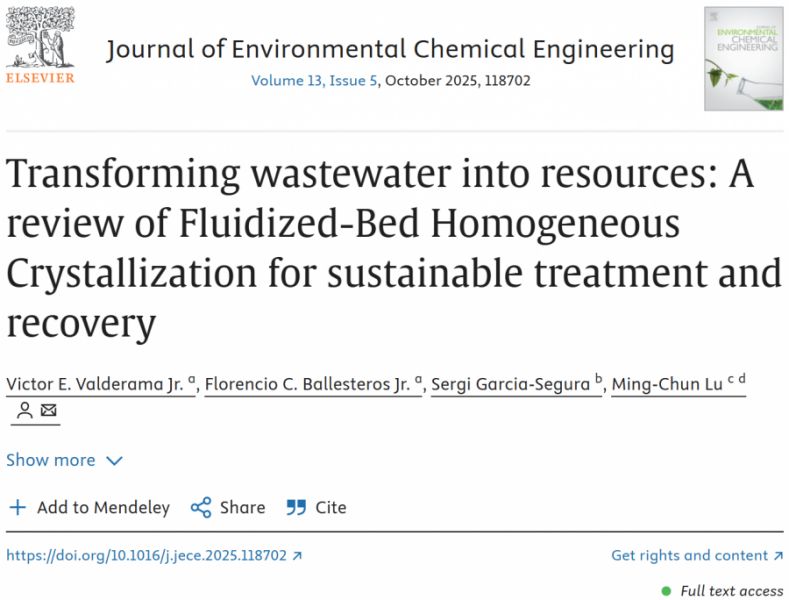
| 論文篇名 | 英文:Transforming wastewater into resources: A review of Fluidized-Bed Homogeneous Crystallization for sustainable treatment and recovery 中文:流體化床均質結晶程序:污染物去除與資源回收的創新方法 |
| 期刊名稱 | Journal of Environmental Chemical Engineering |
| 發表年份,卷數,起迄頁數 | 2025, 13, no.118702 |
| 作者 | Valderama, Victor E.; Ballesteros, Florencio C.; Garcia-Segura, Sergi; Lu, Ming-Chun(盧明俊)* |
| DOI | 10.1016/j.jece.2025.118702 |
| 中文摘要 | 流體化床均質結晶製程(FBHCP)是一項新興的無種晶技術,可在處理工業與合成廢水的同時實現高純度資源回收。本文回顧並分析了40篇經同儕審查的研究,涵蓋金屬、非金屬及混合污染物系統,主要來自電鍍、半導體、農業與礦業領域。在最佳化條件下,FBHCP對銅、鎳、磷酸鹽與草酸鹽等污染物的去除與造粒效率均超過90%,操作條件包括進流水速率0.9–35 mL/min、初始污染物濃度100–500 mg/L、莫耳比1.2–2.0及pH值6.5–10.5。本文亦整合結晶過程的熱力學與動力學原理,並連結至FBHCP設計所需的流體力學控制。技術經濟比較顯示,FBHCP相較傳統沉澱法可減少超過80%的污泥產生,處理成本由每立方米8.92美元降至0.40–1.91美元。所產生的顆粒(如孔雀石、羥基磷灰石、鳥糞石)可直接作為肥料、催化劑或電池前驅物使用,有助於推動循環經濟。FBHCP結合即時監測與機器學習技術,提升操作韌性與擴展性。未來研究應聚焦其長期穩定性、能耗需求及在不同工業廢水條件下的表現,以充分發揮其作為永續解決方案的潛力,並呼應聯合國永續發展目標SDGs第6與12.1項。 |
| 英文摘要 | The Fluidized-Bed Homogeneous Crystallization Process (FBHCP) is an emerging seedless technology that enables high-purity resource recovery while treating industrial and synthetic wastewater. This review critically analyzed 40 peer-reviewed studies on metals, non-metals, and mixed-contaminant systems, primarily from electroplating, semiconductor, agricultural, and mining sectors. FBHCP achieves > 90 % removal and granulation efficiencies for contaminants such as copper, nickel, phosphate, and oxalate under optimized conditions: influent flow rates of 0.9–35 mL/min, initial contaminant concentrations of 100–500 mg/L metal ions or nutrient species, molar ratios of 1.2–2.0, and pH 6.5–10.5. This review also synthesizes the fundamental thermodynamic and kinetic principles governing nucleation and crystallization pathways and links them to hydrodynamic controls essential for FBHCP design. Techno-economic comparisons indicate that FBHCP reduces sludge generation by > 80 % relative to conventional precipitation, decreasing disposal costs from US$8.92/m3 to US $0.40–1.91/m3. The resulting granules—e.g., malachite, hydroxyapatite, struvite—are directly reusable as fertilizers, catalysts, or battery precursors, supporting circular economy goals. FBHCP’s integration with real-time monitoring and machine learning improves operational resilience and scalability. Future research should address its long-term stability, energy demand, and performance under variable industrial effluent conditions to fully realize its potential as a sustainable solution aligned with SDGs 6 and 12.1. |
| 發表成果與本中心研究主題相關性 | 流體化床均質結晶製程(FBHCP)於磷酸銨鎂(MAP)結晶技術中展現高度應用潛力,特別適用於畜牧廢水中氮與磷等營養源的回收。透過控制pH值、莫耳比與流速,FBHCP可有效促進MAP結晶形成,達成高效率去除與造粒,並減少污泥產生。所生成之MAP顆粒具肥料價值,可直接回用於農業,符合循環經濟與資源再利用目標。此技術不僅提升畜牧廢水處理效益,也有助於實現水資源永續與SDGs第6與12項目標。 |