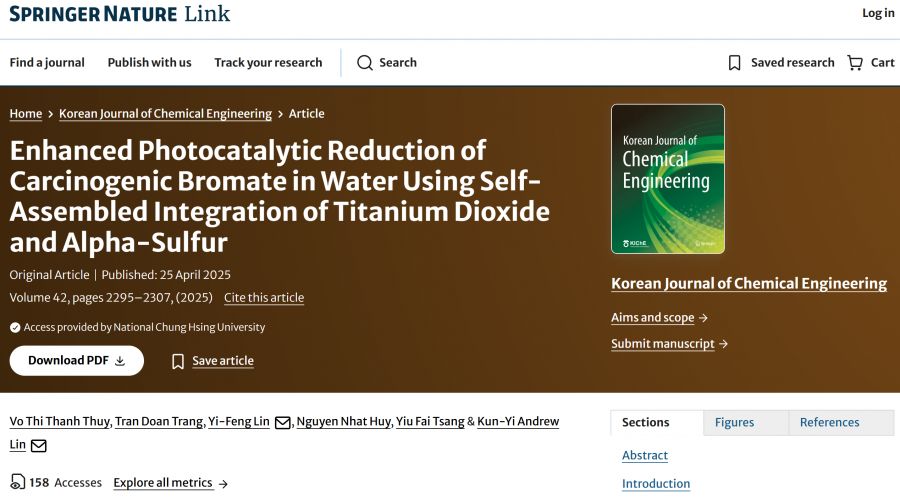
【學術亮點】Enhanced Photocatalytic Reduction of Carcinogenic Bromate in Water Using Self-Assembled Integration of Titanium Dioxide and Alpha-Sulfur
Recycling Agriculture: Valorization of Agricultural Residual Materials【Department of Environmental Engineering / Lin, Kun-Yirew / Distinguished Professor】
循環農業:農業剩餘資材及生質衍生物高值化轉換再利用【環境工程學系/林坤儀特聘教授】
| 論文篇名 | 英文:Enhanced Photocatalytic Reduction of Carcinogenic Bromate in Water Using Self-Assembled Integration of Titanium Dioxide and Alpha-Sulfur 中文:利用二氧化鈦和α-硫的自組裝整合增強光催化還原水中致癌物溴酸鹽 |
| 期刊名稱 | Korean Journal of Chemical Engineering |
| 發表年份,卷數,起迄頁數 | 2025, 42, 2295-2307 |
| 作者 | Thuy, Vo Thi Thanh; Trang, Tran Doan; Lin, Yi-Feng; Huy, Nguyen Nhat; Tsang, Yiu Fai; Lin, Kun-Yi Andrew(林坤儀)* |
| DOI | 10.1007/s11814-025-00464-7 |
| 中文摘要 | 溴酸鹽(BrO₃⁻)是一種具有致癌性的消毒副產物,對人類健康構成嚴重威脅,因此必須有效去除飲用水中的溴酸鹽。光催化技術被視為一種有潛力的方法,可將溴酸鹽還原為溴離子(Br⁻)。 本研究開發了一種新型複合材料——aS/TiO₂(aSTO),透過將二氧化鈦(TiO₂)奈米粒子負載於α-硫(alpha-sulfur, aS)表面上,以提升其在紫外光照射下的還原能力。aSTO複合材料的能隙(bandgap)為2.69 eV,能有效克服純TiO₂的侷限性,如紫外光吸收範圍有限及顆粒聚集問題,從而提高其光催化效率。 我們進行了系列光催化實驗,比較aSTO、TiO₂與aS在溴酸鹽還原中的表現。實驗條件包括不同溫度、pH值,以及硝酸鹽與磷酸鹽等共存陰離子的影響,並進行重複使用測試以評估其可再利用性。結果顯示,aSTO的表現明顯優於TiO₂與aS,在投加量1500 mg/L、反應120分鐘條件下,可達到20 μmol/g的溴酸鹽去除量,顯著高於TiO₂(約15 μmol/g)與aS(約5 μmol/g)。此外,溴酸鹽的還原伴隨化學計量比的溴離子生成,證實了其高效的轉化過程。 在酸性條件及較高溫度下,aSTO的還原效率進一步提升;雖然共存陰離子對反應有輕微抑制作用,但aSTO仍保持良好效能。重複循環實驗證實,aSTO在多次使用後仍能維持其催化活性與結構穩定性。 綜合而言,aSTO展現出優異的可重複使用性與光催化還原性能,具備作為永續性溴酸鹽去除光催化劑應用於實際水處理中的潛力。 |
| 英文摘要 | Bromate (BrO₃⁻), a carcinogenic disinfection by-product, presents significant health risks, requiring its effective removal from drinking water. Photocatalysis offers a promising method for reducing bromate to bromide (Br⁻). In this study, we developed a novel composite material, aS/TiO₂ (aSTO), integrating TiO₂ nanoparticles onto the surface of alpha-sulfur (aS) to enhance reduction under UV irradiation. The aSTO composite, with a bandgap energy of 2.69 eV, addresses the limitations of pure TiO₂, such as limited UV absorption and agglomeration, which reduce its photocatalytic efficiency. We conducted photocatalytic experiments to compare the performance of aSTO, TiO₂, and aS in bromate reduction. The experiments were conducted under varying conditions, including different temperatures, pH levels, and the presence of co-existing anions such as nitrate and phosphate. Recyclability tests were performed to assess the material’s reusability. The aSTO composite outperformed both TiO₂ and aS, achieving up to 20 μmol/g of bromate removal at a dosage of 1500 mg/L over 120 min, with significantly higher bromate removal compared to TiO₂ (~ 15 μmol/g) and aS (~ 5 μmol/g). The reduction of bromate was accompanied by the stoichiometric formation of bromide, confirming the efficient conversion process. Its efficiency improved under acidic conditions and elevated temperatures. Although co-existing anions slightly inhibited the process, aSTO remained highly effective. Recyclability tests confirmed that aSTO retained its catalytic performance and structural integrity over multiple cycles. Overall, aSTO shows great potential as a reusable photocatalyst for sustainable bromate removal in real-world water treatment applications. |
| 發表成果與本中心研究主題相關性 | 透過本研究可進一步建立開發本研究計算所需之觸媒材料,並釐清可適合應用之環境條件! |