【學術亮點】Preparations of P(Acrylamido-2-methylpropane sulfonic acid-co-N,N′-dimethylacrylamide)/P(Acrylamide-co-acrylic acid) tough double network hydrogels as a carrier toward antibacterial applications
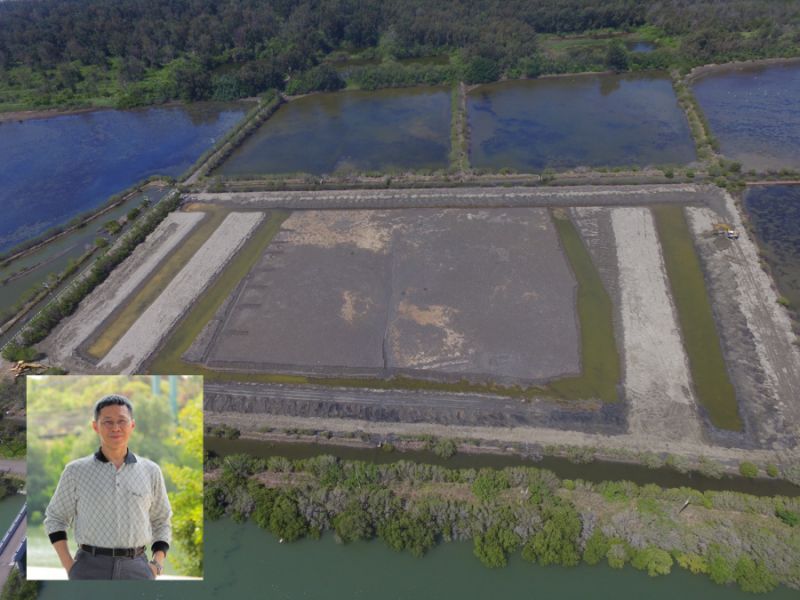
Recycling Agriculture: Valorization of Agricultural Residual Materials【Department of Environmental Engineering / Lin, Kun-Yirew / Distinguished Professor】
循環農業:農業剩餘資材及生質衍生物高值化轉換再利用【環境工程學系/林坤儀特聘教授】
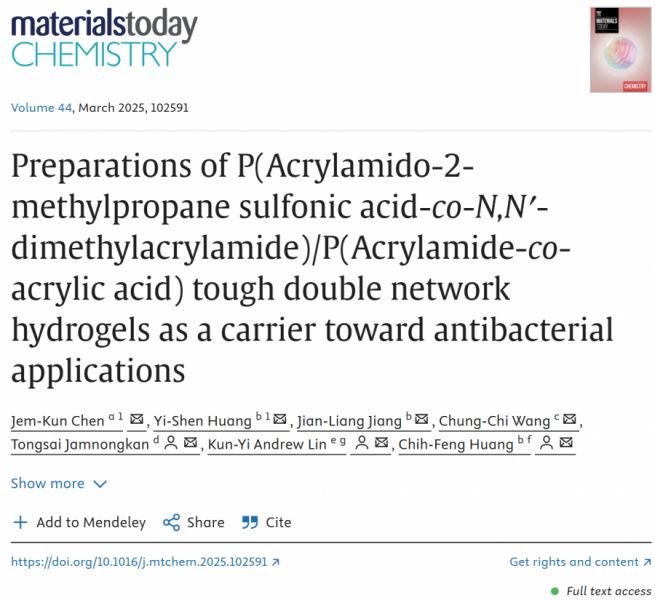
| 論文篇名 | 英文:Preparations of P(Acrylamido-2-methylpropane sulfonic acid-co-N,N′-dimethylacrylamide)/P(Acrylamide-co-acrylic acid) tough double network hydrogels as a carrier toward antibacterial applications 中文:製備以 P(2-丙烯醯胺基-2-甲基丙磺酸-co-N,N′-二甲基丙烯醯胺)/P(丙烯醯胺-co-丙烯酸) 為組成的高韌性雙網絡水凝膠,作為抗菌應用的載體 |
| 期刊名稱 | Materials today chemistry |
| 發表年份,卷數,起迄頁數 | 2025,44, no. 102591 |
| 作者 | Chen, Jem-Kun; Huang, Yi-Shen; Jiang, Jian-Liang; Wang, Chung-Chi; Jamnongkan, Tongsai; Lin, Kun-Yi Andrew(林坤儀)*; Huang, Chih-Feng |
| DOI | 10.1016/j.mtchem.2025.102591 |
| 中文摘要 | 我們採用兩步聚合法製備了雙網絡水凝膠(DN)。在第一網絡的設計中,我們共聚了2-丙烯醯胺基-2-甲基丙磺酸(AMPS)、N,N′-二甲基丙烯醯胺(DMAA)以及交聯劑N,N′-亞甲基雙丙烯醯胺(MBA)。在熱聚合過程中,DMAA與過硫酸鹽之間的自交聯反應與MBA交聯劑的作用同時進行,使單網絡(SN)能形成鏈延伸與交聯結構,既維持一定的吸脹能力,又增加了可犧牲鍵結的數量。 我們利用傅立葉轉換紅外光譜儀(FTIR)、冷凍掃描式電子顯微鏡(cryo-SEM)、熱重分析儀(TGA)、差示掃描量熱儀(DSC)、動態機械分析儀(DMA)以及拉伸測試,分析了單網絡水凝膠(SN)與雙網絡水凝膠(DN)的微觀結構、熱性質及黏彈性。此外,透過拉伸測試進一步觀察了材料的初始斷裂行為與耐久性。 接著,我們將膠束化的薑黃素(Cur)引入DN中作為藥物載體,並利用紫外-可見光吸收光譜(UV–Vis)測量評估其藥物釋放能力,同時分析其釋放模型。初步的抗菌試驗則以金黃色葡萄球菌(*Staphylococcus aureus*, S. aureus)與大腸桿菌(*Escherichia coli*, *E. coli*)為測試菌種,透過抑菌圈實驗評估其抗菌效果。 |
| 英文摘要 | We prepared double network hydrogels (DN) using a two-step polymerization method. In the design of the first network, we copolymerized 2-acrylamido-2-methylpropane sulfonic acid (AMPS), N, N′-dimethylacrylamide (DMAA), and N, N′-methylene bisacrylamide (MBA). Having a combination of the self-crosslinking reaction between DMAA and persulfate and MBA crosslinking agent of the 1st network during thermal polymerization, it forms chain extensions and crosslinked networks with monomers, allowing the SN to maintain a certain swelling capacity while increasing sacrificial bonds. We analyzed the microstructure, thermal properties, and viscoelasticity of single network hydrogels (SN) and DN using Fourier-transform infrared spectroscopy (FTIR), cryo-scanning electron microscope (cryo-SEM), thermogravimetric analyzer (TGA), differential scanning calorimeter (DSC), dynamic mechanical analyzer (DMA) and tensile tests. Furthermore, detailed initial fracture and durability inspections were examined in the tensile test. We then introduced micellized curcumin (Cur) into DN as the drug payload. We evaluated the drug release capability of Cur-loaded DN using UV–Vis absorbance measurements and analyzed the releasing models. Preliminarily, we conducted inhibition zone tests with Staphylococcus aureus (S. A.) and Escherichia coli (E. coli) to assess its antibacterial efficacy. |
| 發表成果與本中心研究主題相關性 | 透過本研究可進一步建立開發本研究計算所需之觸媒材料,並釐清可適合應用之環境條件! |