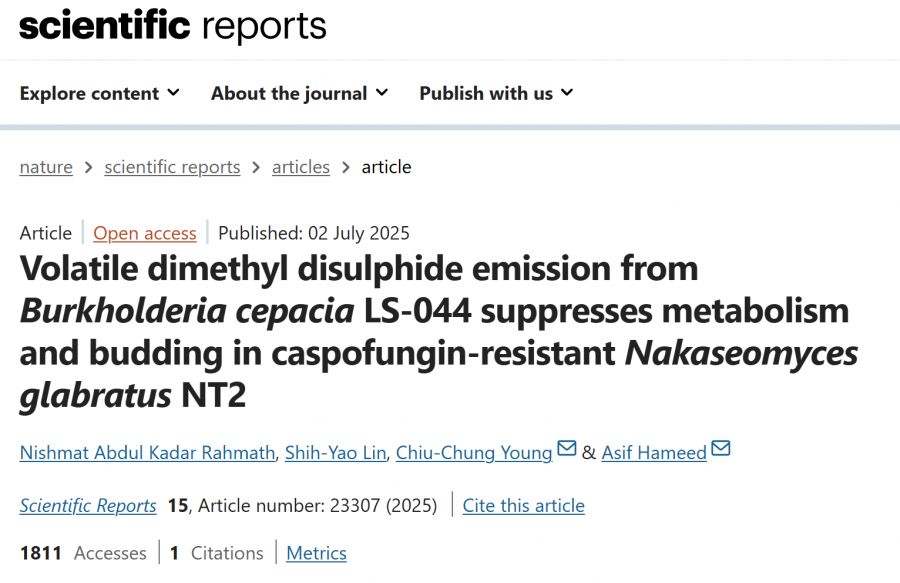
【學術亮點】Volatile dimethyl disulphide emission from Burkholderia cepacia LS-044 suppresses metabolism and budding in caspofungin-resistant Nakaseomyces glabratus NT2
Recycling Agriculture: Development of Integrated All-in-One Technology for the Innovative carbon sequestration of Organic Circular Agriculture【Department of Soil Environmental Sciences / Young, Chiu-Chung / Academician】
循環農業:農業有機循環再利用的多合一創新碳匯技術開發【土壤環境科學系/楊秋忠院士】
| 論文篇名 | 英文:Volatile dimethyl disulphide emission from Burkholderia cepacia LS-044 suppresses metabolism and budding in caspofungin-resistant Nakaseomyces glabratus NT2 中文:由 Burkholderia cepacia LS-044 釋放的揮發性二甲基二硫化物會抑制對 caspofungin 具抗性的 Nakaseomyces glabratus NT2 的代謝與出芽作用 |
| 期刊名稱 | Scientific Reports |
| 發表年份,卷數,起迄頁數 | 2025, 15(1), no.23307 |
| 作者 | Rahmath, Nishmat Abdul Kadar; Lin, Shih-Yao; Young, Chiu-Chung(楊秋忠)*; Hameed, Asif |
| DOI | 10.1038/s41598-025-05383-5 |
| 中文摘要 | Burkholderia cepacia LS-044 能釋放具有抗黴菌效應的揮發性含硫化合物——二甲基二硫化物(DMDS)。本研究證實,DMDS 可顯著抑制對 caspofungin 具抗藥性的酵母 Nakaseomyces glabratus NT2 的代謝、出芽及存活能力。研究團隊在 LS-044 中鑑定出負責 DMDS 合成的基因 mdeA,其編碼為 L-甲硫胺酸-γ-裂解酶。NT2 酵母暴露於 DMDS 後,細胞壁厚度增加、表面積與體積比下降,且其最低抑菌濃度為 0.5%。與抗黴菌藥物 clotrimazole 並用時,未觀察到協同或拮抗作用。此研究揭示了細菌對抗抗藥性酵母的新穎機制,具有潛在的生態與治療應用價值。 |
| 英文摘要 | Burkholderia cepacia LS-044 emits volatile dimethyl disulphide (DMDS), a sulphurous compound with antifungal effects. This study demonstrates that DMDS significantly inhibits metabolism, budding, and viability of the caspofungin-resistant yeast Nakaseomyces glabratus NT2. The gene mdeA, encoding L-methionine-γ-lyase responsible for DMDS production, was identified in LS-044. DMDS exposure led to increased cell wall thickness, reduced surface area-to-volume ratio, and a minimum inhibitory concentration of 0.5%. No synergy or antagonism was observed with clotrimazole. These findings reveal a novel mechanism of bacterial antagonism against drug-resistant yeasts, suggesting potential ecological and therapeutic applications. |
| 發表成果與本中心研究主題相關性 | 本研究所揭示的 以天然微生物代謝物對抗抗藥性真菌與農業淨零碳排與永續發展目標高度契合。利用天然微生物產物替代部分化學農藥,可降低農藥碳足跡,推動低碳農業。若能將此類研究進一步應用於農業植保與病害管理領域,不僅能減碳、減藥,還可強化農業系統的抗壓性與生產安全,為永續農業發展創造更多可能。 |